EN
All hadiths
The complete card collection, filter by chapter
The Noble Qur'an and Qur'anic Sciences
26
The Hadith and Hadith Sciences
3
The Creed
135
Jurisprudence and Juristic Principles
288
Virtues and Manners
288
Da‘wah and Hisbah
15
Seerah and History
38
655 hadiths
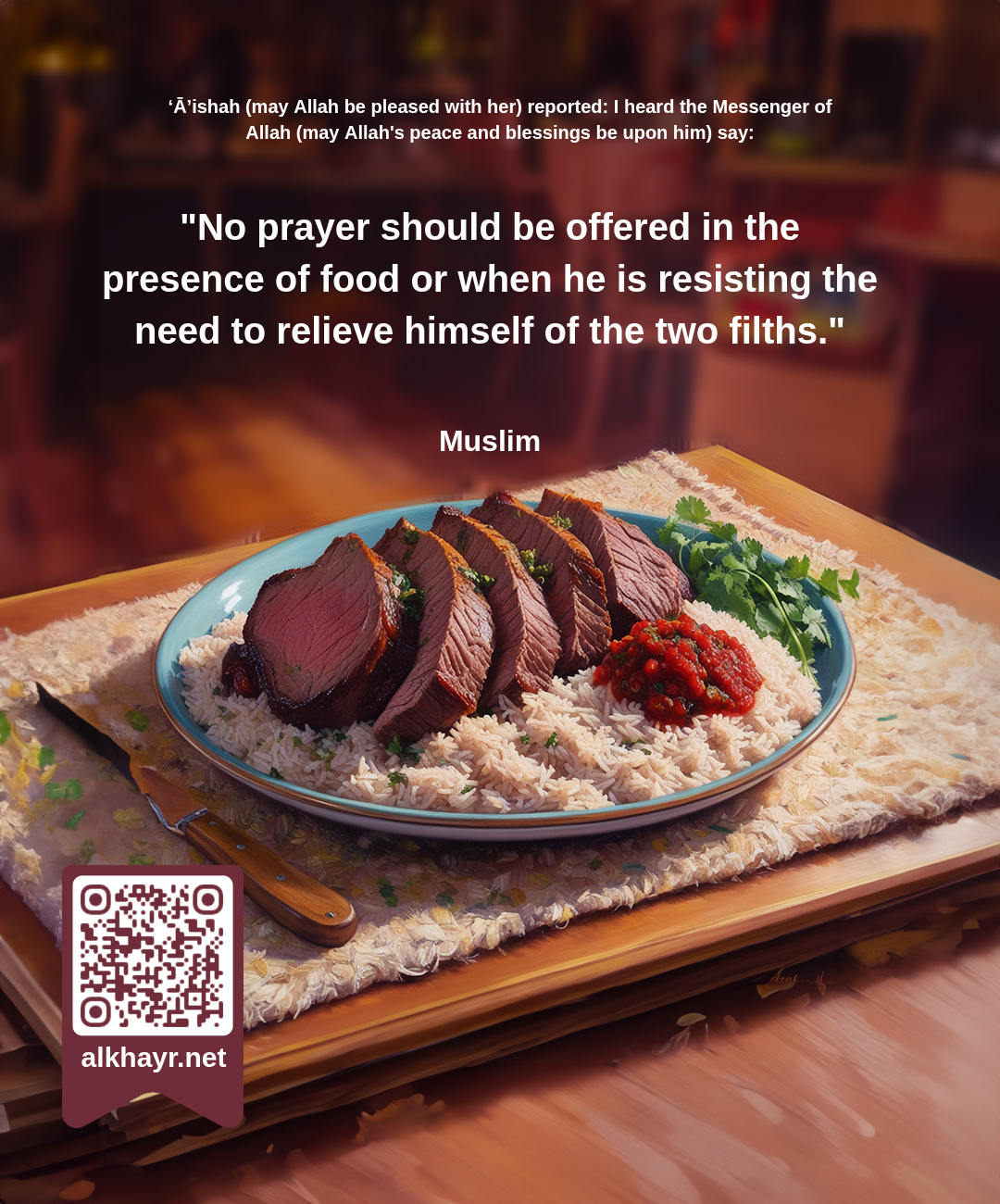
‘Ā’ishah (may Allah be pleased with her) reported: I heard the Messenger of Allah (may Allah's peace and blessings be upon him) say: "No prayer should be offered in the presence of food or when he is resisting the need to relieve himself of the two filths."
Narrated by Muslim
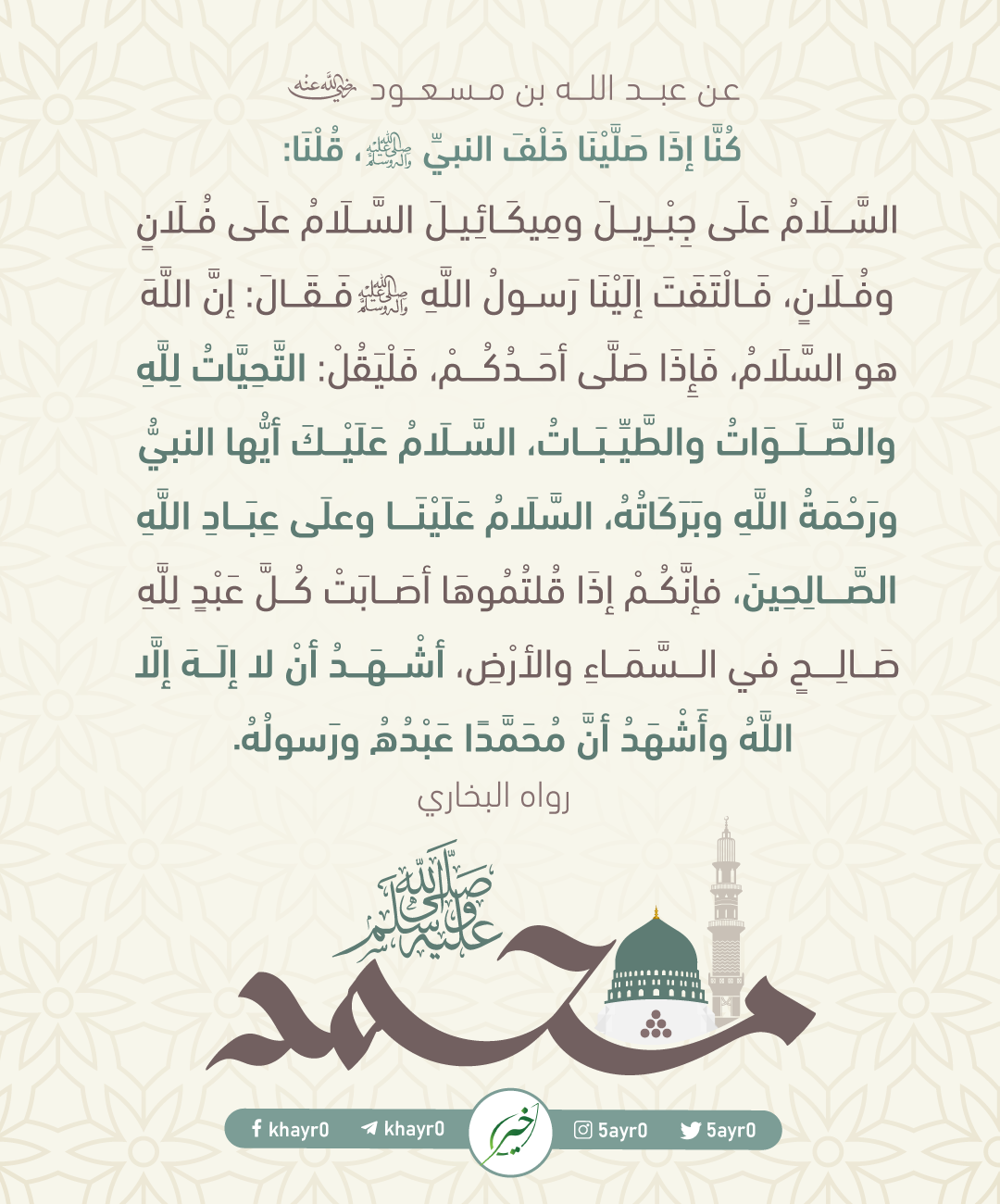
Ibn Mas‘ūd (may Allah be pleased with him) reported: The Messenger of Allah (may Allah's peace and blessings be upon him) taught me the Tashahhud, with my hand between his two hands, as he would teach me a Surah from the Qur’an: "At-tahiyyātu lillāhi was-salawātu wat-tayyibātu as-Salāmu ‘alayka ayyuha an-nabiyyu wa rahmatullāhi wa barakātuh, as-salāmu ‘alayna wa ‘ala ‘ibādillāhi as-sālihīn, ash-hadu alla ilāha illallāh wa ash-hadu anna Muhammadan ‘abduhu wa rasūluh (Greetings, prayers, and good things are due to Allah. May the peace, mercy, and blessings of Allah be upon you, O Prophet. Peace be upon us and upon the righteous slaves of Allah. I bear witness that there is no god but Allah, and I bear witness that Muhammad is His slave and Messenger)." Another wording reads: "Verily, Allah is the Giver of Peace, so when any of you sits in prayer, let him say: 'At-tahiyyātu lillāhi was-salawātu wat-tayyibātu as-salāmu ‘alayka ayyuha an-nabiyyu wa rahmatullāhi wa barakātuh, as-salāmu ‘alayna wa ‘ala ‘ibādillāhi as-sālihīn (Greetings, prayers, and good things are due to Allah. May the peace, mercy, and blessings of Allah be upon you, O Prophet. Peace be upon us and upon the righteous slaves of Allah).' If you say this, it will benefit every righteous slave of Allah in heaven and on earth. (Then, say:) 'Ash-hadu alla ilāha illallāh wa ash-hadu anna Muhammadan ‘abduhu wa rasūluh (I bear witness that there is no god but Allah, and I bear witness that Muhammad is His slave and Messenger).' Then, let him choose whatever supplication he would like."
Agreed upon
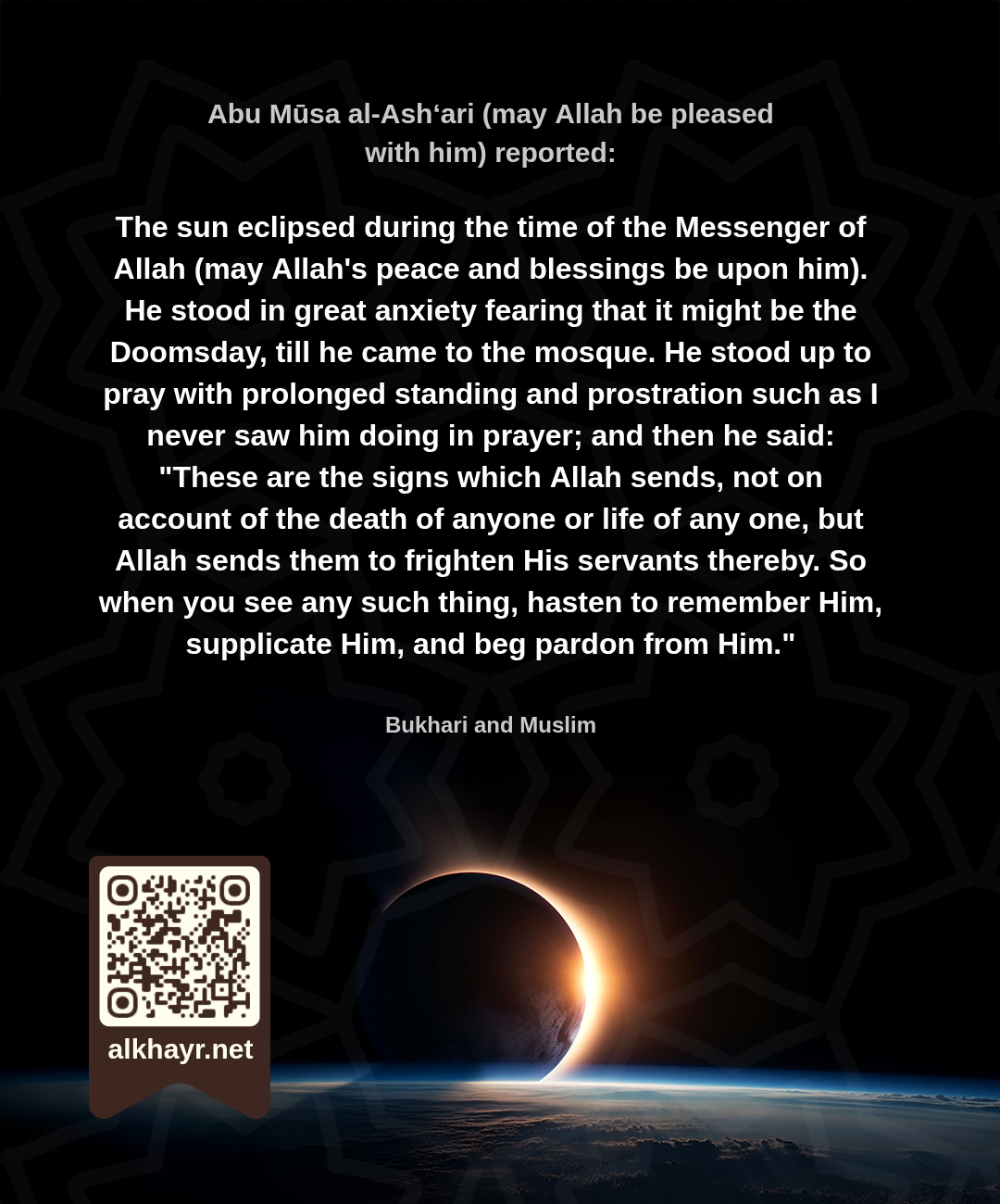
Abu Mūsa al-Ash‘ari (may Allah be pleased with him) reported: The sun eclipsed during the time of the Messenger of Allah (may Allah's peace and blessings be upon him). He stood in great anxiety fearing that it might be the Doomsday, till he came to the mosque. He stood up to pray with prolonged standing and prostration such as I never saw him doing in prayer; and then he said: "These are the signs which Allah sends, not on account of the death of anyone or life of any one, but Allah sends them to frighten His servants thereby. So when you see any such thing, hasten to remember Him, supplicate Him, and beg pardon from Him."
Narrated by Bukhari & Muslim
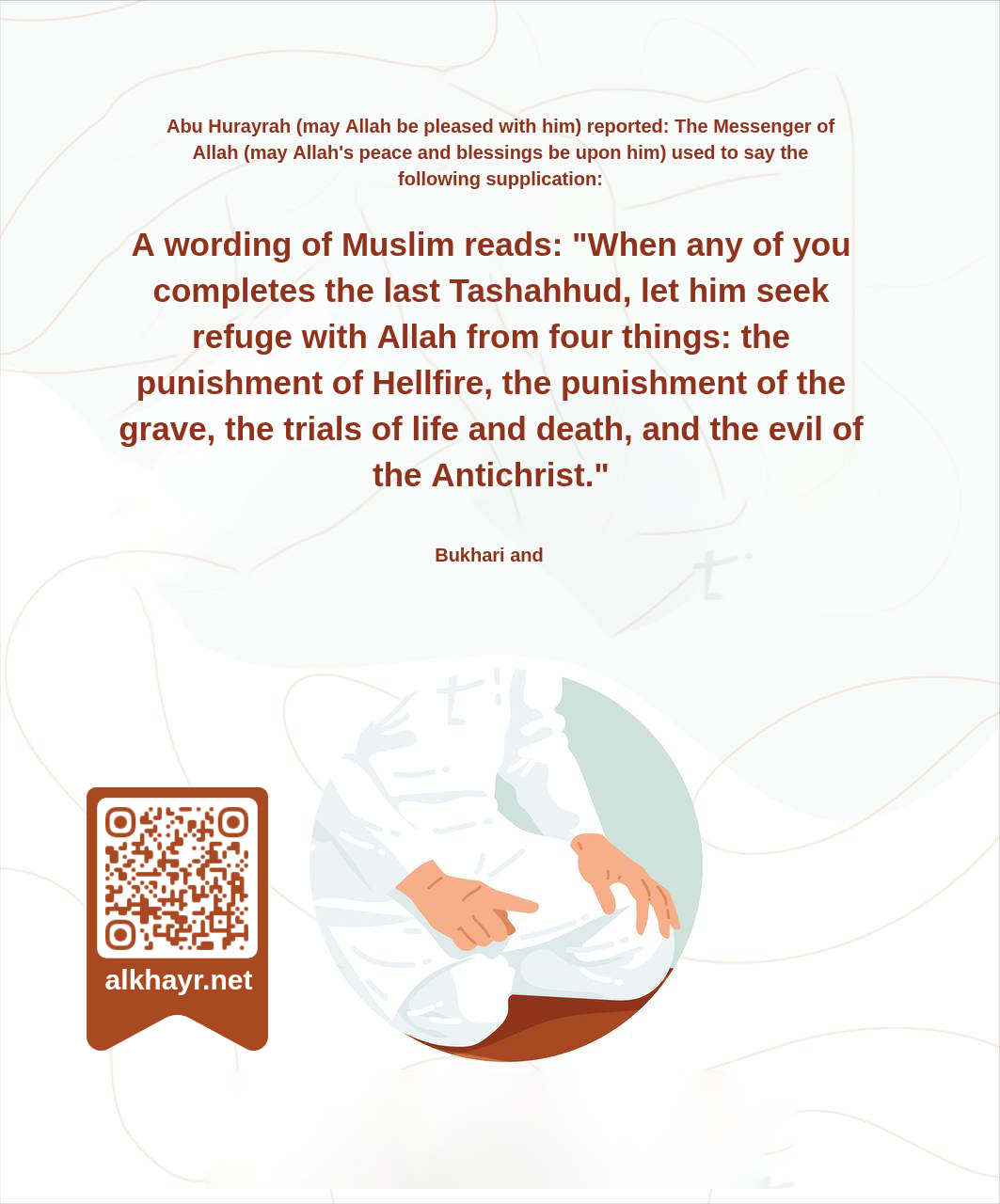
Abu Hurayrah (may Allah be pleased with him) reported: The Messenger of Allah (may Allah's peace and blessings be upon him) used to say the following supplication: "Allāuhumma inni a‘ūdhu bika min ‘adhāb al-qabr, wa min ‘adhāb an-nār, wa min fitnat al-mahya wa al-mamāt, wa min fitnat al-masīh ad-dajjāl (O Allah, I seek refuge with You from the punishment of the grave, the punishment of the Fire, the trials of life and death, and the trial of the Dajjāl (Antichrist)." A wording of Muslim reads: "When any of you completes the last Tashahhud, let him seek refuge with Allah from four things: the punishment of Hellfire, the punishment of the grave, the trials of life and death, and the evil of the Antichrist."
Agreed upon
Abu Hurayrah (may Allah be pleased with him) reported: When the Messenger of Allah (may Allah's peace and blessings be upon him) made Takbīr in the prayer, he would remain silent a while before reciting. I said: O Messenger of Allah, may my father and mother ransom you! Have you seen your silence between Takbīr and the recitation? What is it that you say? He said: "I say: Allāhumma bā‘id bayni wa bayna khatāyāy kama bā‘dta bayna al-mashriqi wa al-maghrib. Allāhumma naqqini min khatāyāy kama yunaqqa ath-thawbu al-abyadu min ad-danas. Allāhumma ighsilni min khatāyāy bith-thalji wa al-mā’i wa al-barad (O Allah, distance me from my sins as You have distanced the east from the west. O Allah, purify me from my sins as a white garment is purified from dirt. O Allah, wash out my sins with water, snow, and hail)."
Agreed upon
Abu Hurayrah (may Allah be pleased with him) reported: The Messenger of Allah (may Allah's peace and blessings be upon him) said: "If you say to your companion 'listen' on Friday while the Imām is delivering the sermon, you have thus engaged in idle talk."
Agreed upon
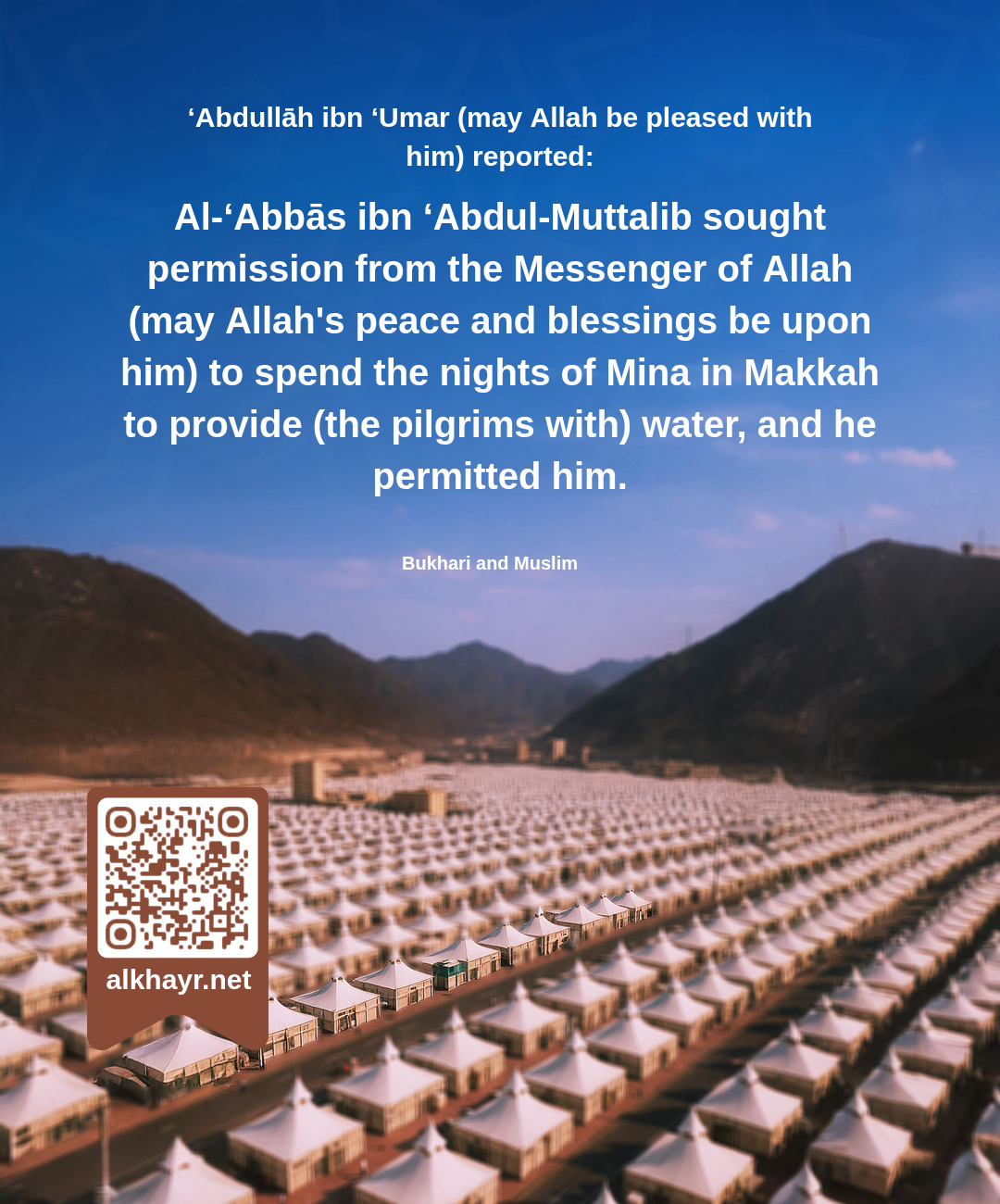
‘Abdullāh ibn ‘Umar (may Allah be pleased with him) reported: Al-‘Abbās ibn ‘Abdul-Muttalib sought permission from the Messenger of Allah (may Allah's peace and blessings be upon him) to spend the nights of Mina in Makkah to provide (the pilgrims with) water, and he permitted him.
Narrated by Bukhari & Muslim
Abu Hurayrah (may Allah be pleased with him) reported that the Prophet (may Allah's peace and blessings be upon him) said: "Hasten with the funeral, for if it is righteous, you will be taking it forward to what is good; and if it is otherwise, you will be laying evil off your necks."
Agreed upon
Mirdās al-Aslami (may Allah be pleased with him) reported that the Prophet (may Allah's peace and blessings be upon him) said: "Righteous people will go (die) one after another. Meanwhile, the dregs of people, like waste barley or dates, will remain. Allah will not raise them in esteem."
Narrated by Bukhari
Abu Hurayrah (may Allah be pleased with him) reported: The Prophet (may Allah's peace and blessings be upon him) said: "A man follows the religion (i.e. ways and manners) of his close friend. So, each of you should carefully consider whom he takes as his intimate friend."
Narrated by Abu Dāwūd, At-Tirmidhi, and Ahmad
Anas ibn Mālik (may Allah be pleased with him) reported: There were two brothers during the time of the Prophet (may Allah's peace and blessings be upon him). One of them used to come to the Prophet (may Allah's peace and blessings be upon him) and the other used to work to earn a living. Once, the working brother complained to the Prophet (may Allah's peace and blessings be upon him) about his brother. Thereupon, he replied: "Perhaps you are granted sustenance because of him."
Narrated by At-Termedhy
Abu Mūsa (may Allah be pleased with him) reported that the Prophet (may Allah's peace and blessings be upon him) said: "Verily, the example of the righteous companion and the evil companion is like that of the carrier of the musk and the blower of the bellows. The carrier of the musk will either give you, or you will buy from him, or you will get a pleasant smell from him, and the blower of the bellows will either burn your clothes or you will get an offensive smell."
Agreed upon
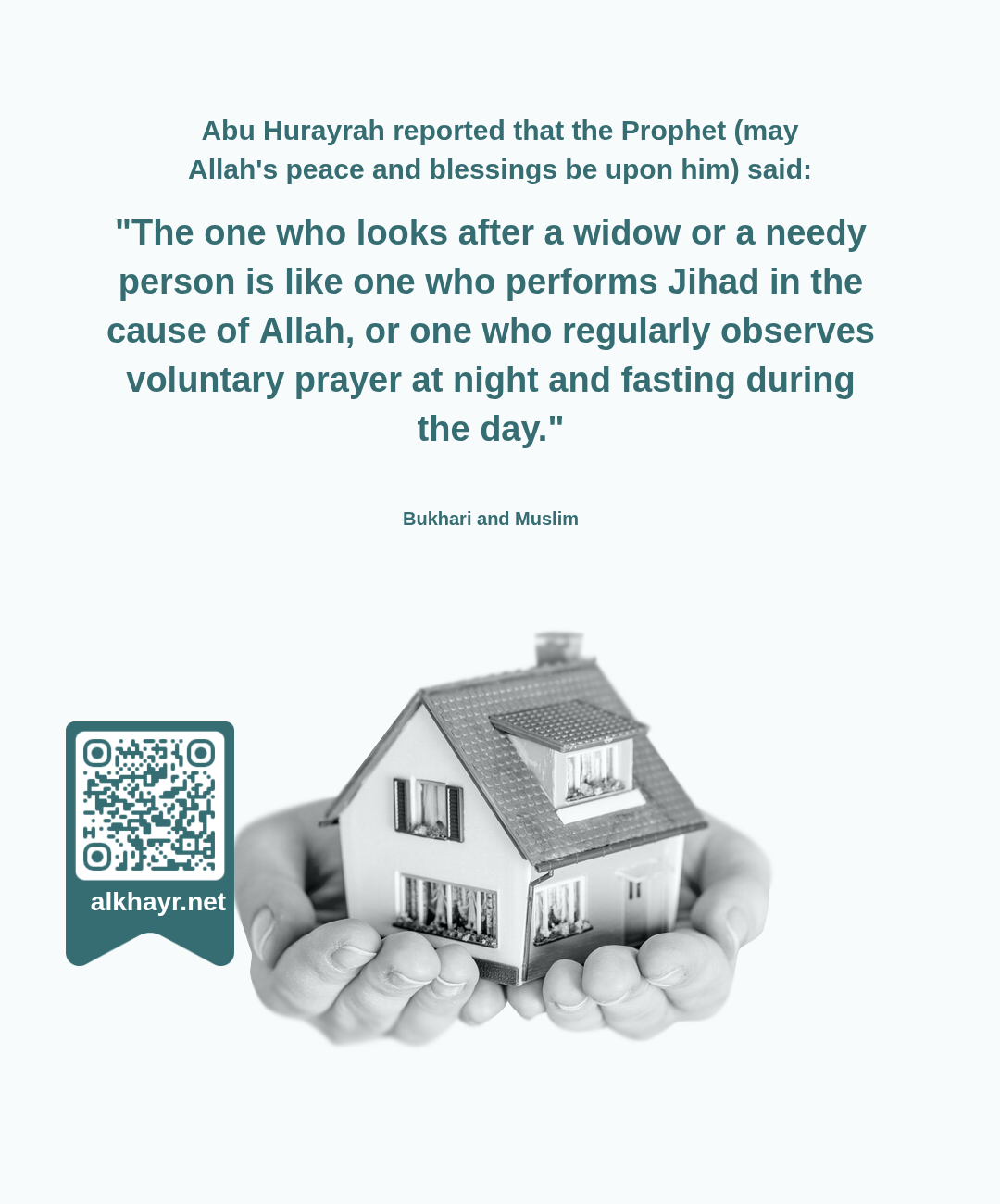
Abu Hurayrah reported that the Prophet (may Allah's peace and blessings be upon him) said: "The one who looks after a widow or a needy person is like one who performs Jihad in the cause of Allah, or one who regularly observes voluntary prayer at night and fasting during the day."
Agreed upon
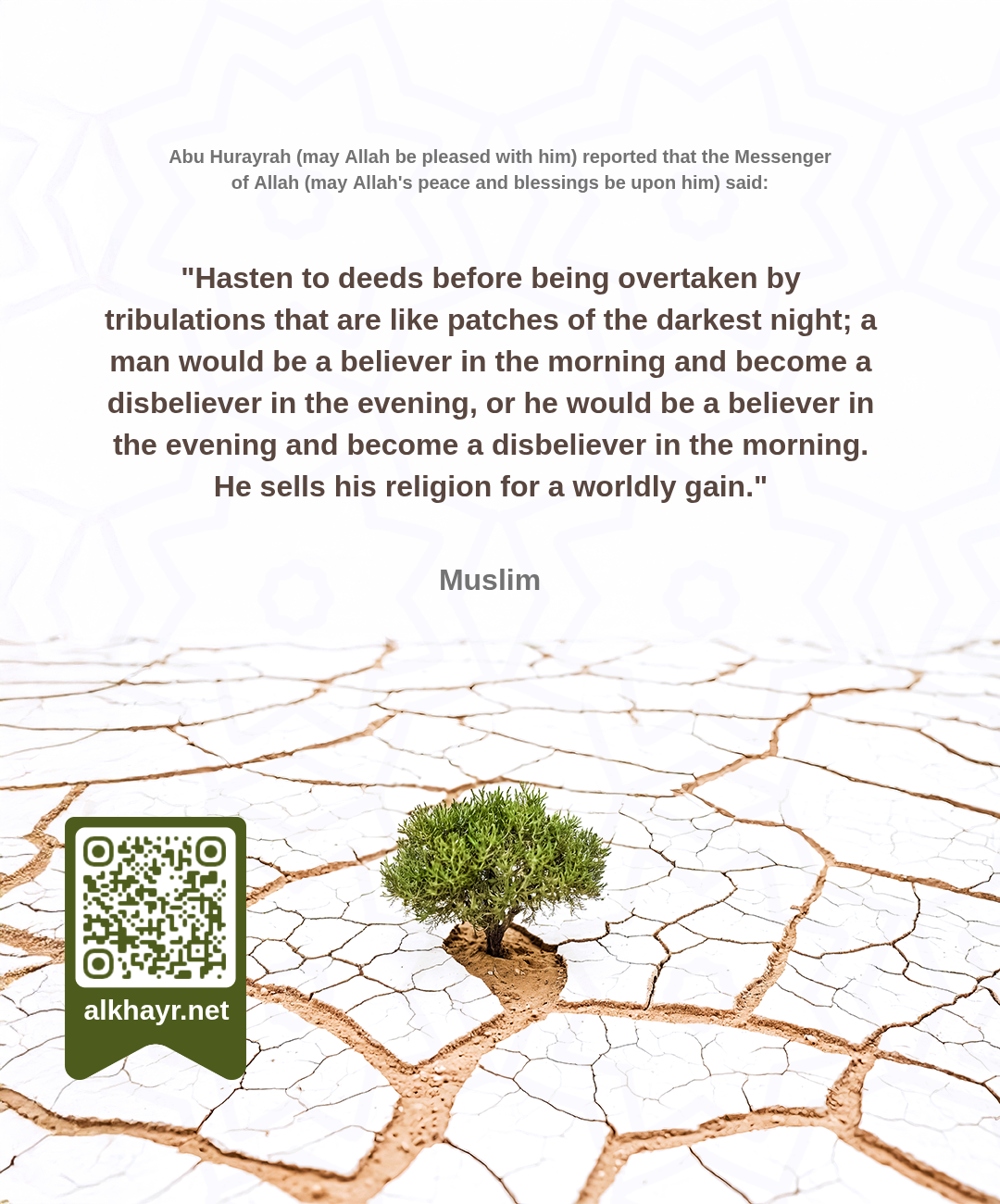
Abu Hurayrah (may Allah be pleased with him) reported that the Messenger of Allah (may Allah's peace and blessings be upon him) said: "Hasten to deeds before being overtaken by tribulations that are like patches of the darkest night; a man would be a believer in the morning and become a disbeliever in the evening, or he would be a believer in the evening and become a disbeliever in the morning. He sells his religion for a worldly gain."
Narrated by Muslim
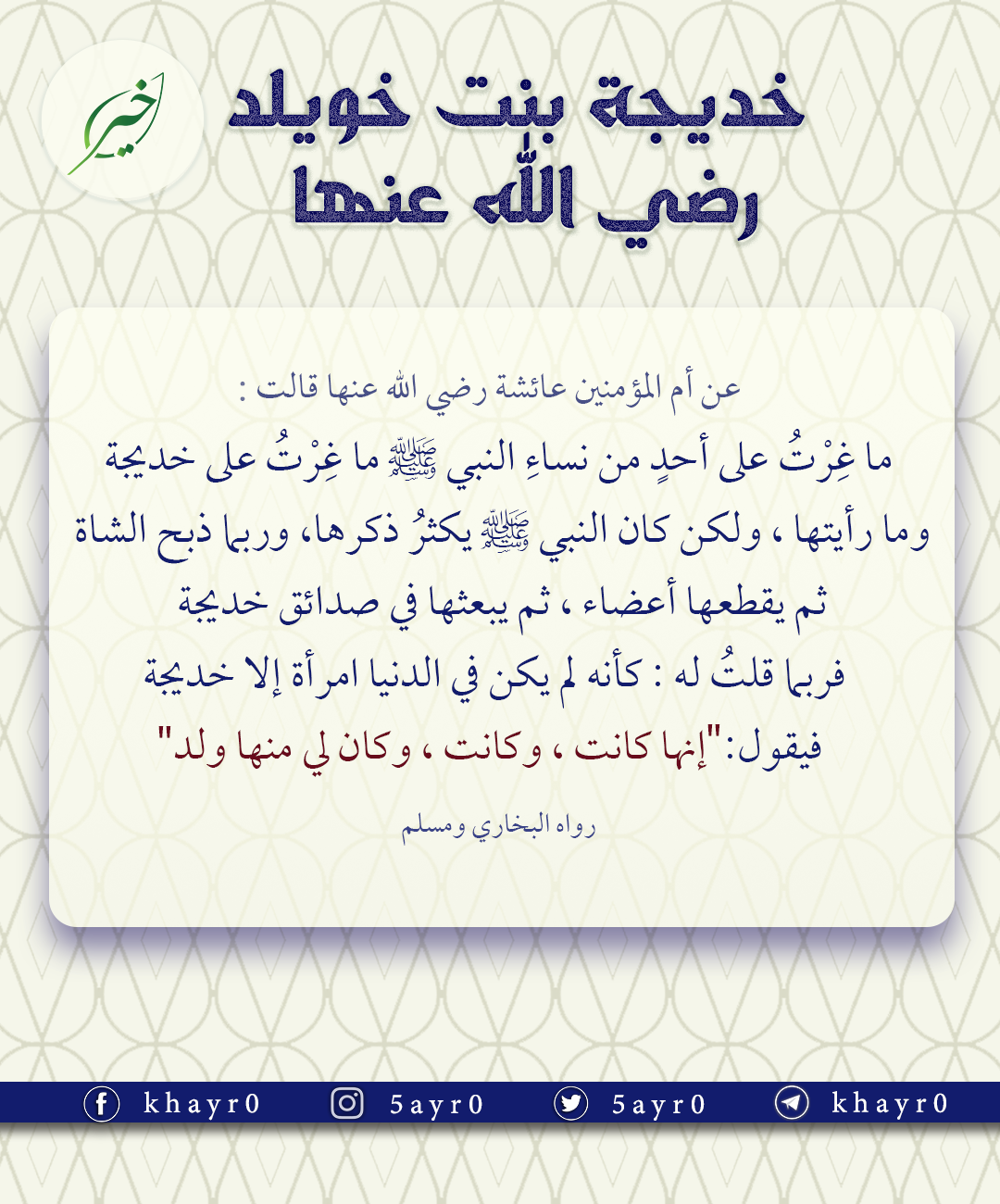
‘Ā’ishah (may Allah be pleased with her) reported: I never felt jealous of any of the Prophet's wives more than I felt jealous of Khadījah (may Allah be pleased with her). I never saw her, but he used to mention her a lot. He would slaughter a sheep and cut it into pieces and then send (gifts of meat) to the friends of Khadījah. I would sometimes say to him: "It is as if there was none in the world except Khadījah!" And he would say: "She was such-and-such, and I had children from her." In another narration: "He would slaughter a sheep and send enough meat to her close friends." In a third narration: "When he slaughtered a sheep, he would say: 'Send it to the friends of Khadījah.'" In a fourth narration: "Hālah bint Khuwaylid, the sister of Khadījah, asked for permission to enter unto the Messenger of Allah (may Allah's peace and blessings be upon him). So he remembered the way Khadījah would seek permission. This pleased him, and he said: 'O Allah, (let it be) Hālah bint Khuwaylid.'"
Narrated by Bukhari & Muslim due to its all chains of narrators
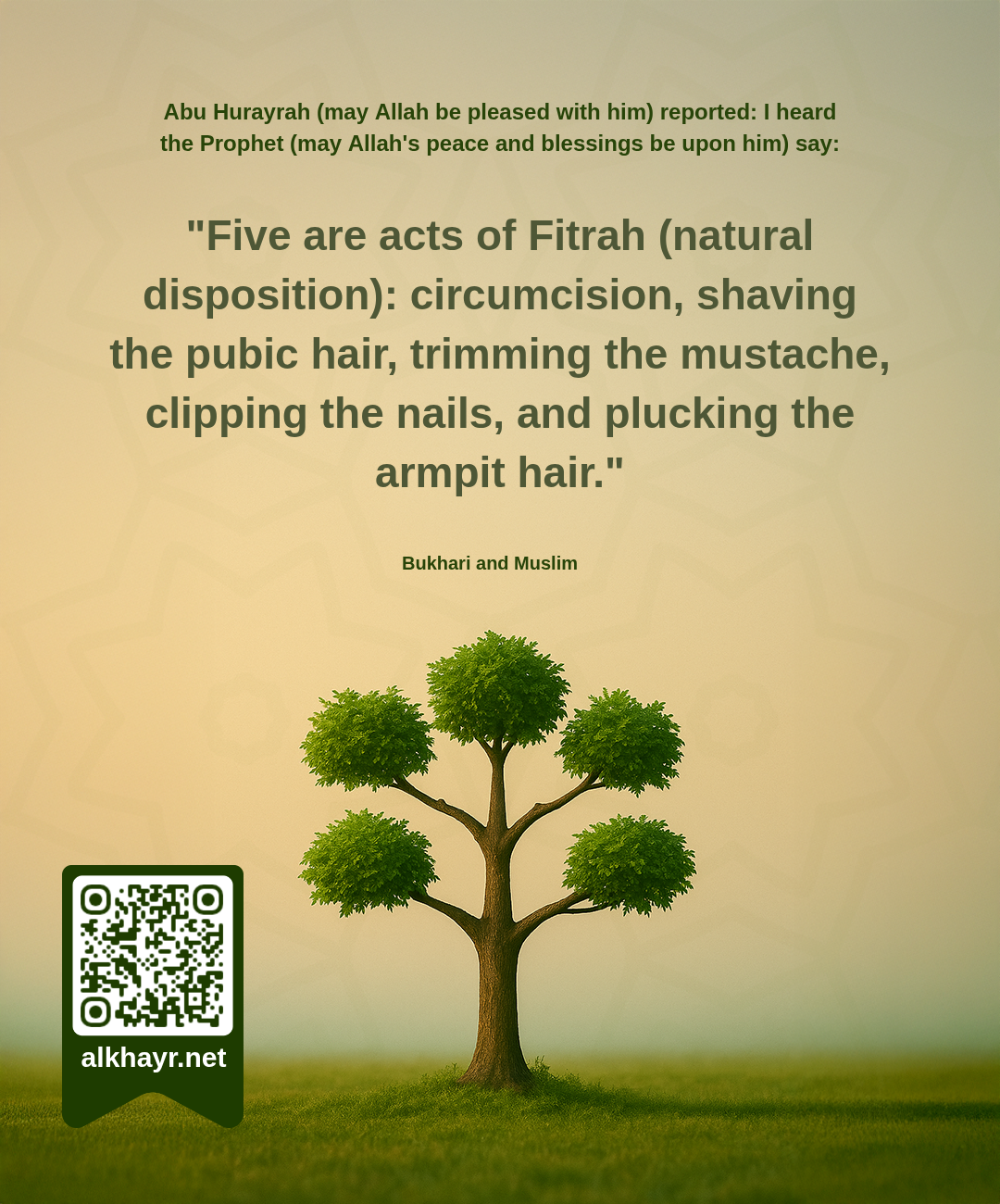
Abu Hurayrah (may Allah be pleased with him) reported: I heard the Prophet (may Allah's peace and blessings be upon him) say: "Five are acts of Fitrah (natural disposition): circumcision, shaving the pubic hair, trimming the mustache, clipping the nails, and plucking the armpit hair."
Agreed upon
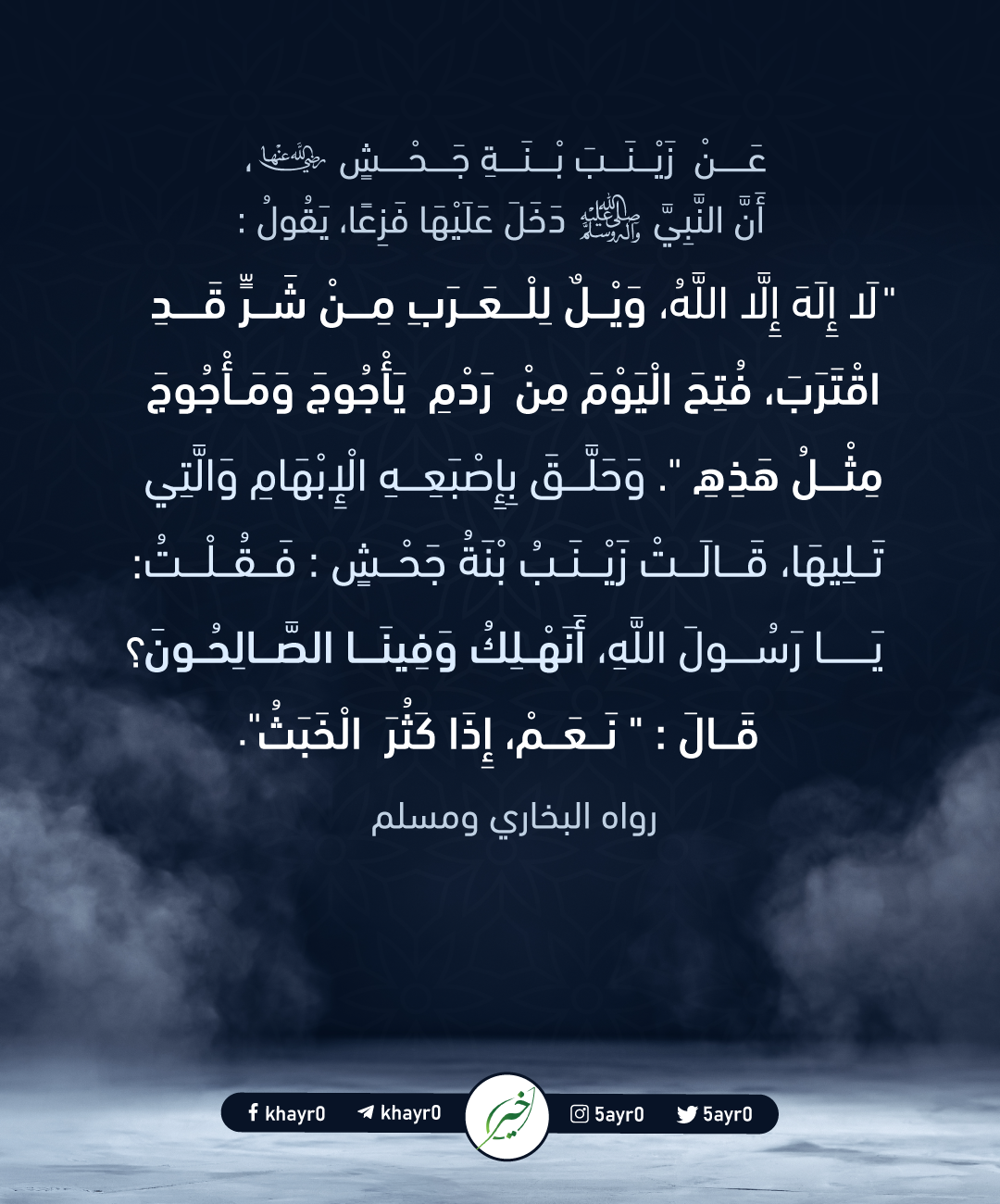
Zaynab bint Jahsh (may Allah be pleased with her) reported: The Prophet (may Allah's peace and blessings be upon him) came to her in an alarmed state, saying: "There is no god but Allah. Woe to the Arabs from an impending evil. Today, an opening has been made in the wall of Gog and Magog, like this," making a circle with his thumb and index fingers. Zaynab bint Jahsh said: So, I said: "O Messenger of Allah, shall we perish while there are pious people among us?" He said: "Yes, when wickedness becomes rampant."
Agreed upon
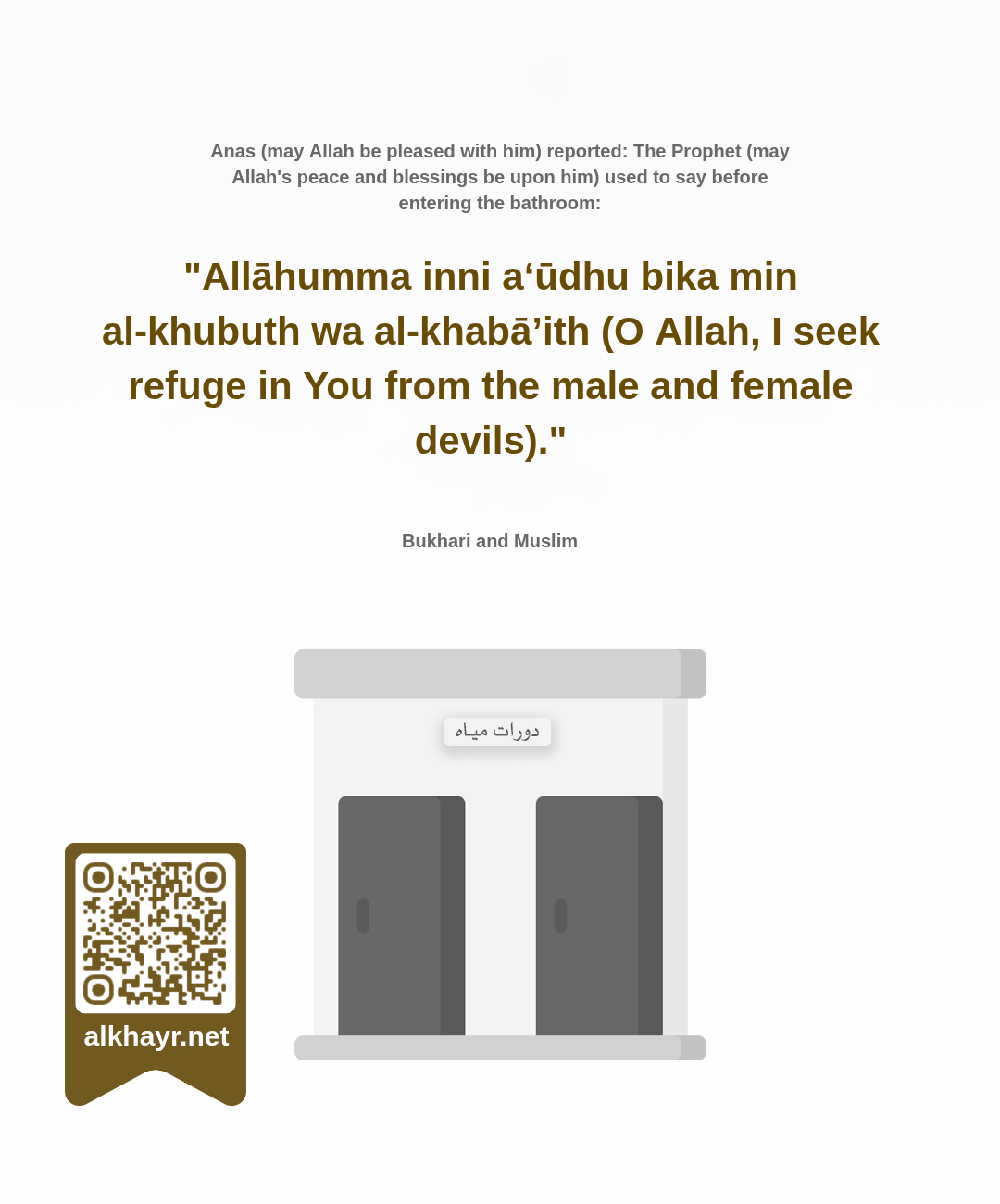
Anas (may Allah be pleased with him) reported: The Prophet (may Allah's peace and blessings be upon him) used to say before entering the bathroom: "Allāhumma inni a‘ūdhu bika min al-khubuth wa al-khabā’ith (O Allah, I seek refuge in You from the male and female devils)."
Agreed upon
Abu Sa‘īd al-Khudri (may Allah be pleased with him) reported: The Prophet (may Allah's peace and blessings be upon him) was more bashful than a virgin in her boudoir. Whenever he saw something he disliked, we could perceive that on his face.
Agreed upon
Abu Hurayrah (may Allah be pleased with him) reported: The Messenger of Allah (may Allah's peace and blessings be upon him) said: "The believer, man or woman, will continue to be tested concerning his or her self, children, and property until they meet Allah without any sins in their record."
Narrated by At-Tirmidhi and Ahmad
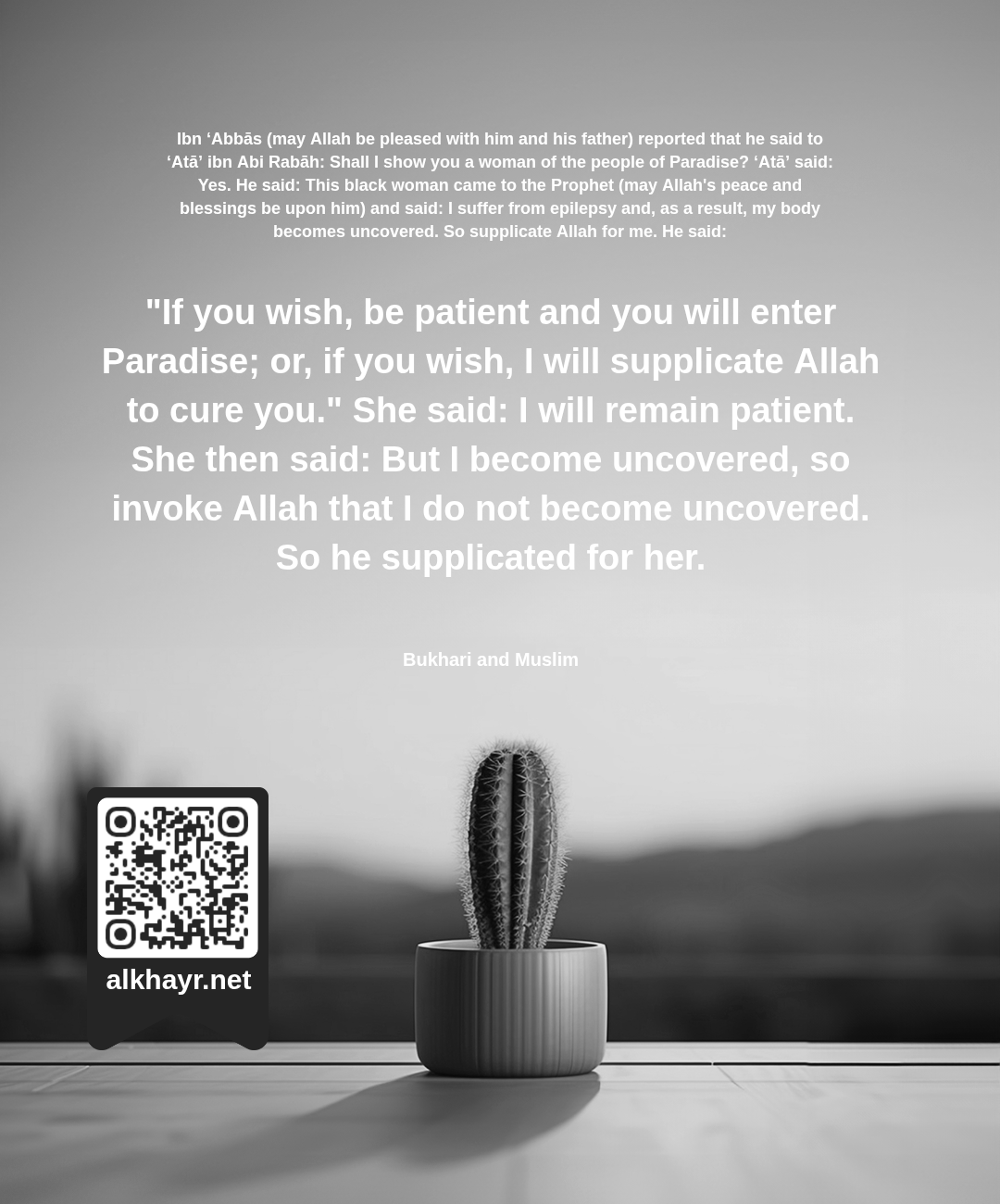
Ibn ‘Abbās (may Allah be pleased with him and his father) reported that he said to ‘Atā’ ibn Abi Rabāh: Shall I show you a woman of the people of Paradise? ‘Atā’ said: Yes. He said: This black woman came to the Prophet (may Allah's peace and blessings be upon him) and said: I suffer from epilepsy and, as a result, my body becomes uncovered. So supplicate Allah for me. He said: "If you wish, be patient and you will enter Paradise; or, if you wish, I will supplicate Allah to cure you." She said: I will remain patient. She then said: But I become uncovered, so invoke Allah that I do not become uncovered. So he supplicated for her.
Agreed upon
‘Ā’ishah (may Allah be pleased with her) reported that she asked the Messenger of Allah (may Allah's peace and blessings be upon him) about the plague. He told her that it was a torment that Allah would send upon whom He willed. Then Allah made it a mercy for the believers, so anyone in an area afflicted with plague who stays therein patiently hoping for Allah's reward and believing that nothing will befall him except what Allah has foreordained for him will get a reward similar to that of a martyr.
Narrated by Bukhari
Abu Hurayrah (may Allah be pleased with him) reported that the Prophet (may Allah's peace and blessings be upon him) said: "Allah, the Exalted, said: 'My reward shall be nothing less than Paradise for My faithful servant who, if I take the life of his beloved one from the inhabitants of the world, he bears it patiently in expectation of My reward.'"
Narrated by Bukhari
Abu Hurayrah (may Allah be pleased with him) reported that the Prophet (may Allah's peace and blessings be upon him) said: “‘Do you know who is the bankrupt?" They said: "The bankrupt among us is the one who has neither money nor property." He said: "The bankrupt in my Ummah is the one who will come on the Day of Judgment with prayer, fasting and Zakat, but since he hurled abuse at others, accused others of committing adultery without evidence, unlawfully consumed the wealth of others, and shed the blood of others and beat others, his good deeds will be credited to the accounts of others (who suffered at his hands), and if his good deeds fall short to clear his account, others' sins will be cast on him and he will then be thrown in the Fire."
Narrated by Muslim
Previous page
Page 3 of 28
Next page