Hadith for the World
Jurisprudence and Juristic Principles

Jurisprudence of Acts of Worship

231 hadiths

231 hadiths

Ibn ‘Abbās (may Allah be pleased with him and his father) reported: The Messenger of Allah (may Allah's peace and blessings be upon him) said to a woman from the Ansār—Ibn ‘Abbās named her, but I forgot her name—"What prevented you from performing Hajj with us?" She said: We only had two camels, and the father of her son and her son performed Hajj on one camel and left us a camel to carry water on. He said: "Perform ‘Umrah when Ramadan comes, for ‘Umrah in it is equivalent to Hajj."Agreed upon
Fadālah ibn ‘Ubayd, Salmān Al-Fārisi, and ‘Uqbah ibn ‘Āmir al-Juhani (may Allah be pleased with them) reported that the Prophet (may Allah’s peace and blessings be upon him) said: "The actions of every dead person come to a halt except the one who is garrisoned on the frontier in the way of Allah. His deeds will keep growing till the Day of Judgment, and he will be secure from the trial in the grave."Narrated by At-Termedhy - Narrated by Abu Daoud - Narrated by Ahmad
Abu Hurayrah (may Allah be pleased with him) reported: I heard the Messenger of Allah (may Allah’s peace and blessings be upon him) say: "Whoever performs Hajj without engaging in rafath (sexual relations or obscene speech) or sinning will return like the day his mother gave birth to him."Agreed upon
‘Ā’ishah, Mother of the Believers, (may Allah be pleased with her) reported saying: O Messenger of Allah, we consider Jihad the best deed; should we not perform Jihad? He said, "No; rather, the best Jihad is Mabrūr (accepted) Hajj."Narrated by Al-Bukhāri
Ibn ‘Umar (may Allah be pleased with him and his father) reported: The Messenger of Allah (may Allah's peace and blessings be upon him) said: "When Allah gathers the first and the last on the Day of Judgment, a banner will be raised for every traitor, and it will be said: This is the betrayal of so-and-so, the son of so-and-so."Agreed upon
‘Abdullāh ibn ‘Umar (may Allah be pleased with him) reported that a woman was found killed in one of the expeditions of the Prophet (may Allah's peace and blessings be upon him), and so the Messenger of Allah (may Allah's peace and blessings be upon him) denounced killing women and boys.Agreed upon
‘Abdullāh ibn Abu Awfa (may Allah be pleased with him) reported: The Messenger of Allah (may Allah's peace and blessings be upon him) during one of the days wherein he met the enemy, waited until the sun had declined. Thereafter, he stood up among them and said: "O people, do not wish to meet the enemy, and ask Allah for safety. And if you meet them, have patience and know that Paradise lies under the shadows of swords." Then, the Prophet (may Allah's peace and blessings be upon him) said: "O Allah, Revealer of the Book, Mover of the Clouds, Defeater of the Armies, Defeat them and help us against them!"Narrated by Bukhari & Muslim
Sahl ibn Sa‘d as-Sā‘idi (may Allah be pleased with him) reported that the Messenger of Allah (may Allah's peace and blessings be upon him) said: "Observing Ribāt (guarding the Muslims' frontiers) for one day in the cause of Allah is better than the world and everything in it. The place occupied by the whip of one of you in Paradise is better than the world and everything in it. The evening or morning walk that one takes in the cause of Allah is better than the world and everything in it."Agreed upon
Abu Mūsa (may Allah be pleased with him) reported: The Messenger of Allah (may Allah's peace and blessings be upon him) was asked about a man who fights out of valor, fights out of chauvinism, and fights out of ostentation. Which one of them is in the cause of Allah? The Messenger of Allah (may Allah's peace and blessings be upon him) said: "Whoever fights so that the word of Allah be supreme is indeed in the cause of Allah."Agreed upon
Abu Hurayrah (may Allah be pleased with him) reported that the Messenger of Allah (may Allah's peace and blessings be upon him) said: "No one is wounded in the way of Allah except that he comes on the Day of Judgment with his wound bleeding; the color is that of blood, and the smell is that of musk."Narrated by Bukhari & Muslim
‘Abdullāh ibn Abi Awfa (may Allah be pleased with him) reported: We participated with the Messenger of Allah (may Allah's peace and blessings be upon him) in seven battles wherein we ate locusts.Narrated by Bukhari & Muslim
Abu Sa‘īd al-Khudri (may Allah be pleased with him) reported that the Messenger of Allah (may Allah's peace and blessings be upon him) said: "When you hear the Adhan (call to prayer), repeat what the Muezzin says."Agreed upon
Al-Mughīrah (may Allah be pleased with him) reported: Once I was in the company of the Prophet (may Allah's peace and blessings be upon him) on a journey and I bent down to take off his leather socks, but he said: "Leave them, for I had put them on when they were in the state of purity." So, he wiped over them.Agreed upon
‘Abdullāh ibn ‘Umar (may Allah be pleased with him) reported that the Messenger of Allah (may Allah’s peace and blessings be upon him) entered Makkah from Kadā', from the upper mountain pass which is in Al-Bat-hā', and exited from the lower mountain pass.Narrated by Bukhari & Muslim
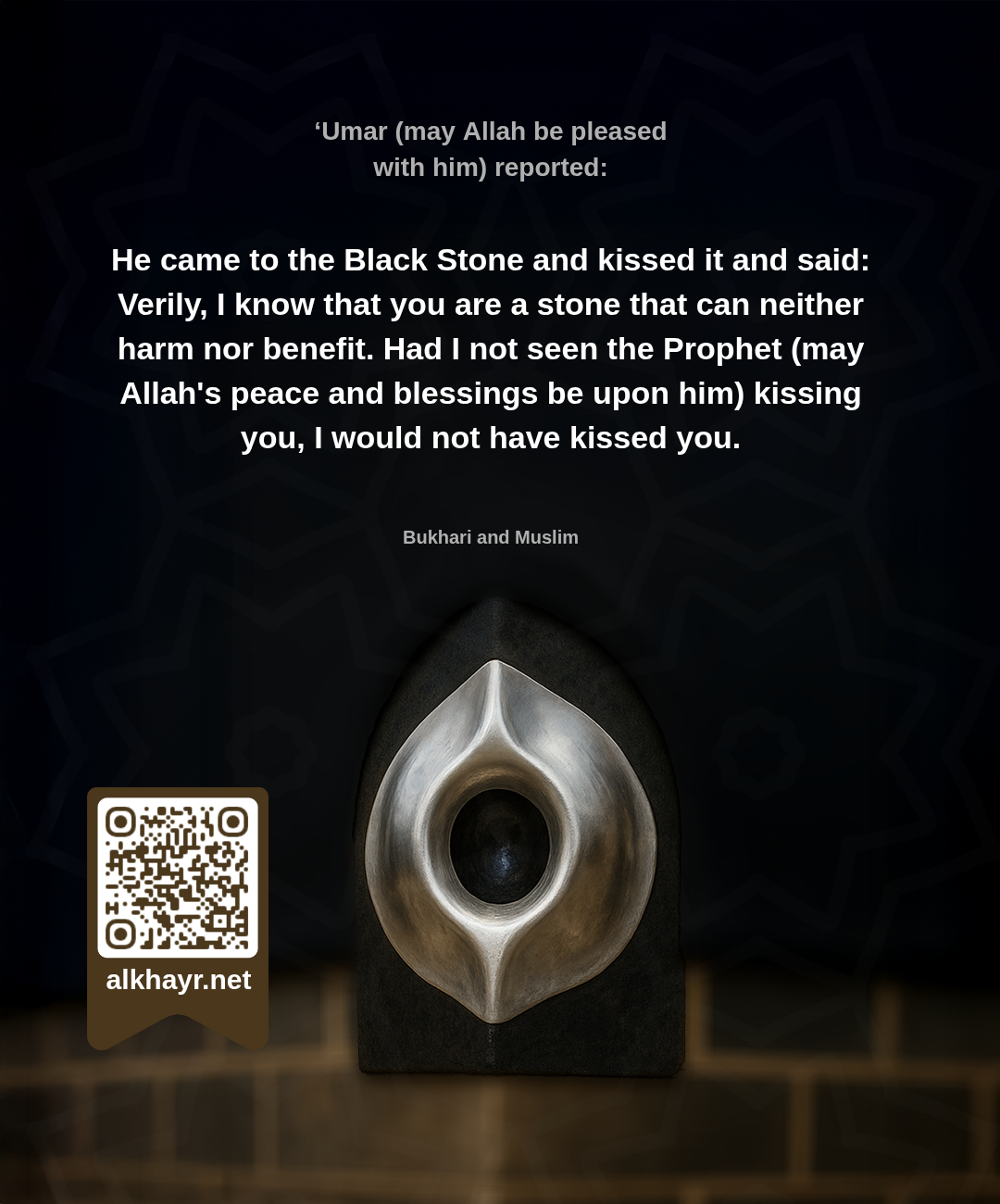
‘Umar (may Allah be pleased with him) reported: He came to the Black Stone and kissed it and said: Verily, I know that you are a stone that can neither harm nor benefit. Had I not seen the Prophet (may Allah's peace and blessings be upon him) kissing you, I would not have kissed you.Agreed upon
Anas ibn Mālik (may Allah be pleased with him) reported: The Messenger of Allah (may Allah's peace and blessings be upon him) said: "Straighten your rows, for indeed, straightening the row is from the perfection of the prayer."Agreed upon
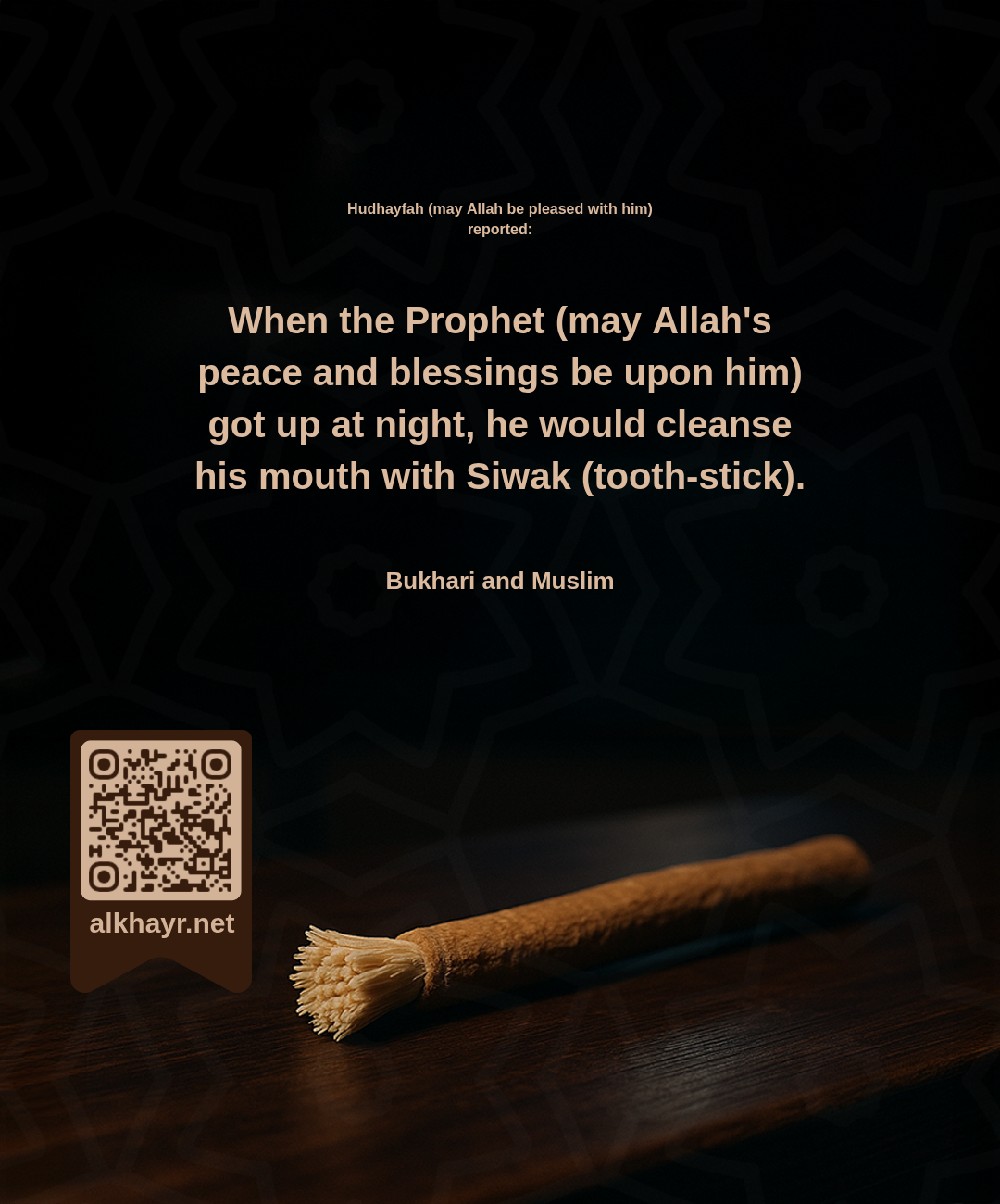
Hudhayfah (may Allah be pleased with him) reported: When the Prophet (may Allah's peace and blessings be upon him) got up at night, he would cleanse his mouth with Siwak (tooth-stick).Agreed upon
‘Abdullāh ibn Zayd ibn ‘Āsim al-Māzini (may Allah be pleased with him) reported that a complaint was made to the Prophet (may Allah’s peace and blessings be upon him) about the person who doubts that something (breaking his ablution) has happened to him during his prayer, and he said: "He should not leave (his prayer) unless he hears a sound or perceives a smell."Narrated by Bukhari & Muslim
Abu Hurayrah (may Allah be pleased with him) reported that the Prophet (may Allah's peace and blessings be upon him) said: "Is he who raises his head before the Imam not afraid that Allah may transform his head into that of a donkey or his shape into that of a donkey?"Agreed upon
‘Ā’ishah (may Allah be pleased with her) reported: I heard the Messenger of Allah (may Allah's peace and blessings be upon him) say: "No prayer should be offered in the presence of food or when he is resisting the need to relieve himself of the two filths."Narrated by Muslim
Ibn Mas‘ūd (may Allah be pleased with him) reported: The Messenger of Allah (may Allah's peace and blessings be upon him) taught me the Tashahhud, with my hand between his two hands, as he would teach me a Surah from the Qur’an: "At-tahiyyātu lillāhi was-salawātu wat-tayyibātu as-Salāmu ‘alayka ayyuha an-nabiyyu wa rahmatullāhi wa barakātuh, as-salāmu ‘alayna wa ‘ala ‘ibādillāhi as-sālihīn, ash-hadu alla ilāha illallāh wa ash-hadu anna Muhammadan ‘abduhu wa rasūluh (Greetings, prayers, and good things are due to Allah. May the peace, mercy, and blessings of Allah be upon you, O Prophet. Peace be upon us and upon the righteous slaves of Allah. I bear witness that there is no god but Allah, and I bear witness that Muhammad is His slave and Messenger)." Another wording reads: "Verily, Allah is the Giver of Peace, so when any of you sits in prayer, let him say: 'At-tahiyyātu lillāhi was-salawātu wat-tayyibātu as-salāmu ‘alayka ayyuha an-nabiyyu wa rahmatullāhi wa barakātuh, as-salāmu ‘alayna wa ‘ala ‘ibādillāhi as-sālihīn (Greetings, prayers, and good things are due to Allah. May the peace, mercy, and blessings of Allah be upon you, O Prophet. Peace be upon us and upon the righteous slaves of Allah).' If you say this, it will benefit every righteous slave of Allah in heaven and on earth. (Then, say:) 'Ash-hadu alla ilāha illallāh wa ash-hadu anna Muhammadan ‘abduhu wa rasūluh (I bear witness that there is no god but Allah, and I bear witness that Muhammad is His slave and Messenger).' Then, let him choose whatever supplication he would like."Agreed upon
Abu Mūsa al-Ash‘ari (may Allah be pleased with him) reported: The sun eclipsed during the time of the Messenger of Allah (may Allah's peace and blessings be upon him). He stood in great anxiety fearing that it might be the Doomsday, till he came to the mosque. He stood up to pray with prolonged standing and prostration such as I never saw him doing in prayer; and then he said: "These are the signs which Allah sends, not on account of the death of anyone or life of any one, but Allah sends them to frighten His servants thereby. So when you see any such thing, hasten to remember Him, supplicate Him, and beg pardon from Him."Narrated by Bukhari & Muslim
Abu Hurayrah (may Allah be pleased with him) reported: The Messenger of Allah (may Allah's peace and blessings be upon him) used to say the following supplication: "Allāuhumma inni a‘ūdhu bika min ‘adhāb al-qabr, wa min ‘adhāb an-nār, wa min fitnat al-mahya wa al-mamāt, wa min fitnat al-masīh ad-dajjāl (O Allah, I seek refuge with You from the punishment of the grave, the punishment of the Fire, the trials of life and death, and the trial of the Dajjāl (Antichrist)." A wording of Muslim reads: "When any of you completes the last Tashahhud, let him seek refuge with Allah from four things: the punishment of Hellfire, the punishment of the grave, the trials of life and death, and the evil of the Antichrist."Agreed upon

Abu Hurayrah (may Allah be pleased with him) reported: When the Messenger of Allah (may Allah's peace and blessings be upon him) made Takbīr in the prayer, he would remain silent a while before reciting. I said: O Messenger of Allah, may my father and mother ransom you! Have you seen your silence between Takbīr and the recitation? What is it that you say? He said: "I say: Allāhumma bā‘id bayni wa bayna khatāyāy kama bā‘dta bayna al-mashriqi wa al-maghrib. Allāhumma naqqini min khatāyāy kama yunaqqa ath-thawbu al-abyadu min ad-danas. Allāhumma ighsilni min khatāyāy bith-thalji wa al-mā’i wa al-barad (O Allah, distance me from my sins as You have distanced the east from the west. O Allah, purify me from my sins as a white garment is purified from dirt. O Allah, wash out my sins with water, snow, and hail)."Agreed upon