126 hadiths
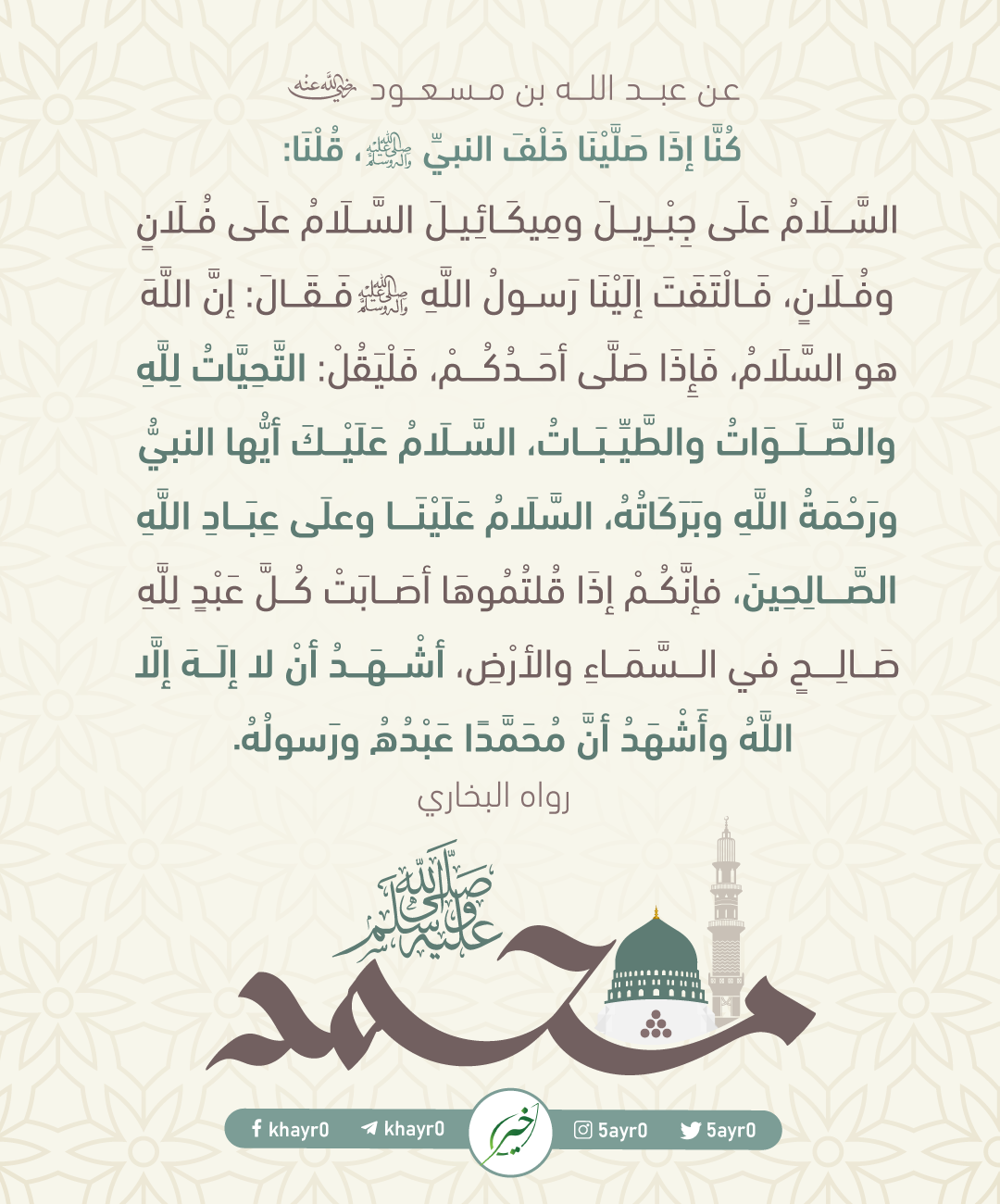 Ibn Mas‘ūd (may Allah be pleased with him) reported: The Messenger of Allah (may Allah's peace and blessings be upon him) taught me the Tashahhud, with my hand between his two hands, as he would teach me a Surah from the Qur’an: "At-tahiyyātu lillāhi was-salawātu wat-tayyibātu as-Salāmu ‘alayka ayyuha an-nabiyyu wa rahmatullāhi wa barakātuh, as-salāmu ‘alayna wa ‘ala ‘ibādillāhi as-sālihīn, ash-hadu alla ilāha illallāh wa ash-hadu anna Muhammadan ‘abduhu wa rasūluh (Greetings, prayers, and good things are due to Allah. May the peace, mercy, and blessings of Allah be upon you, O Prophet. Peace be upon us and upon the righteous slaves of Allah. I bear witness that there is no god but Allah, and I bear witness that Muhammad is His slave and Messenger)." Another wording reads: "Verily, Allah is the Giver of Peace, so when any of you sits in prayer, let him say: 'At-tahiyyātu lillāhi was-salawātu wat-tayyibātu as-salāmu ‘alayka ayyuha an-nabiyyu wa rahmatullāhi wa barakātuh, as-salāmu ‘alayna wa ‘ala ‘ibādillāhi as-sālihīn (Greetings, prayers, and good things are due to Allah. May the peace, mercy, and blessings of Allah be upon you, O Prophet. Peace be upon us and upon the righteous slaves of Allah).' If you say this, it will benefit every righteous slave of Allah in heaven and on earth. (Then, say:) 'Ash-hadu alla ilāha illallāh wa ash-hadu anna Muhammadan ‘abduhu wa rasūluh (I bear witness that there is no god but Allah, and I bear witness that Muhammad is His slave and Messenger).' Then, let him choose whatever supplication he would like."Agreed upon
 Abu Hurayrah (may Allah be pleased with him) reported: The Messenger of Allah (may Allah's peace and blessings be upon him) used to say the following supplication: "Allāuhumma inni a‘ūdhu bika min ‘adhāb al-qabr, wa min ‘adhāb an-nār, wa min fitnat al-mahya wa al-mamāt, wa min fitnat al-masīh ad-dajjāl (O Allah, I seek refuge with You from the punishment of the grave, the punishment of the Fire, the trials of life and death, and the trial of the Dajjāl (Antichrist)." A wording of Muslim reads: "When any of you completes the last Tashahhud, let him seek refuge with Allah from four things: the punishment of Hellfire, the punishment of the grave, the trials of life and death, and the evil of the Antichrist."Agreed upon
 Jābir ibn ‘Abdullah (may Allah be pleased with him and his father) reported: The Messenger of Allah (may Allah's peace and blessings be upon him) used to teach us Istikhārah (guidance-seeking prayer) in all matters, as he would teach us a Surah from the Qur’an. He would say: "When one of you intends to do something, let him perform two Rak‘ahs other than the obligatory prayer and then say: Allāhumma inni astakhīruka bi‘ilmika, wa astaqdiruka biqudratika, wa as’aluka min fadlik al-‘azhīm, fa ’innaka taqdiru wa la aqdiru, wa ta‘lamu wa la a‘lamu, wa anta ‘allāmu al-ghuyūb. Allāhumma in kunta ta‘lamu anna hādha al-’amra khayrun li fi dīni wa ma‘āshi wa ‘āqibati amri, (or he said) ‘ājili amri wa ājilihi, faqdurhu li wa yassirhu li, thumma bārik li fīh. Wa in kunta ta‘lamu anna hādha al-’amra sharrun li fi dīni wa ma‘āshi wa ‘āqibati amri, (or he said) wa ‘ājili amri wa ājilihi, fasrifhu ‘anni, wasrifni ‘anhu, waqdur li al-khayra haythu kāna, thumma ardini. (O Allah, I consult You for Your knowledge, and I seek strength from You for Your power, and I ask You of Your great bounty. Indeed, You are capable and I am not, and You know and I do not, and You are the All-Knower of the unseen. O Allah, if You know that this matter is good for me in my religion, my livelihood, and the outcome of my affairs, (or he said), my immediate and future affairs, then decree it for me, make it easy for me, and then bless it for me. And if You know this matter is evil concerning my religion, my livelihood or the outcome of my affairs, (or he said) my immediate and future affairs, then turn it away from me, and turn me away from it, and decree for me what is good wherever it may be, and make me content).'' He said: ''And let him name his need.''Narrated by Al-Bukhāri
 Mu‘ādh ibn Jabal (may Allah be pleased with him) reported: The Messenger of Allah (may Allah's peace and blessings be upon him) took his hand and said: "O Mu‘ādh, by Allah, I do love you," and he added: "I advise you, O Mu‘ādh, never fail to say after each prayer: Allāhumma a‘inni ‘ala dhikrika wa shukrika wa husni ‘ibādatik (O Allah, help me remember You, thank You, and excellently worship You)."Narrated by Abu Dāwūd, An-Nasā’i, and Ahmad