Hadith for the World
Jurisprudence and Juristic Principles

Jurisprudence of Acts of Worship

231 hadiths

231 hadiths

‘Ā’ishah (may Allah be pleased with her) reported that the Messenger of Allah (may Allah's peace and blessings be upon him) said: "Seek out the Night of Qadr (Decree) in the odd nights of the last ten of Ramadan."Agreed upon
‘Umar ibn al-Khattāb (may Allah be pleased with him) reported: The Messenger of Allah (may Allah’s peace and blessings be upon him) said: "When the night approaches from this side, and the day retreats from that side, then it is time for the fasting person to break his fast."Narrated by Bukhari & Muslim
Ibn ‘Umar (may Allah be pleased with him and his father) reported: I heard the Messenger of Allah (may Allah's peace and blessings be upon him) say: "Fast when you see it, and break the fast when you see it, but if the sky is overcast and you cannot see it, then act on estimation."Agreed upon
Abu Hurayrah (may Allah be pleased with him) reported that the Messenger of Allah (may Allah's peace and blessings be upon him) said: "A man's prayer in congregation is twenty-something degrees higher than his prayer in his house and market. When one performs ablution and perfects it, then goes out to the mosque, nothing motivates him except prayer and seeking nothing but prayer. For every step he takes, he is raised one degree and one sin is erased for him until he enters the mosque. When he enters the mosque, he remains in prayer as long as prayer is what keeps him therein. The angels will keep invoking the blessings of Allah on you as long as you are in the place where you performed prayer, saying: 'O Allah, have mercy on him! O Allah, forgive him! O Allah, accept his repentance!' as long as you do not harm anyone therein and do not break your ablution."Agreed upon
Abu Dharr (may Allah be pleased with him) reported that the Prophet (may Allah's peace and blessings be upon him) said: "The deeds of my Ummah, the good and the bad thereof, were presented to me. I found the removal of harm from the road among their good deeds, and the spittle in a mosque that was not buried among their bad deeds."Narrated by Muslim
‘Ā'ishah (may Allah be pleased with her) reported: When the Messenger of Allah (may Allah's peace and blessings be upon him) missed prayer at night because of sickness or otherwise, he would pray twelve Rak‘ahs during the daytime.Narrated by Muslim
‘Ā'ishah and Al-Mughīrah ibn Shu‘bah (may Allah be pleased with both of them) reported: The Prophet (may Allah's peace and blessings be upon him) used to stand in prayer at night until the skin of his feet would crack. I (‘Ā'ishah) asked him: "O Messenger of Allah, why are you doing this while your past and future sins have been forgiven for you?" He said: "Should I not like to be a grateful slave (of Allah)?"Narrated by Bukhari & Muslim
Abu Hurayrah (may Allah be pleased with him) reported that the Messenger of Allah (may Allah's peace and blessings be upon him) said: "The places that are dearest to Allah are the mosques, and the places that are most hateful to Allah are the marketplaces."Narrated by Muslim
‘Ā’ishah, Mother of the Believers, (may Allah be pleased with her) reported: With the start of the ten, the Messenger of Allah (may Allah's peace and blessings be upon him) would revive the night, wake up his family, exert himself, and tighten up the lower garment.Agreed upon
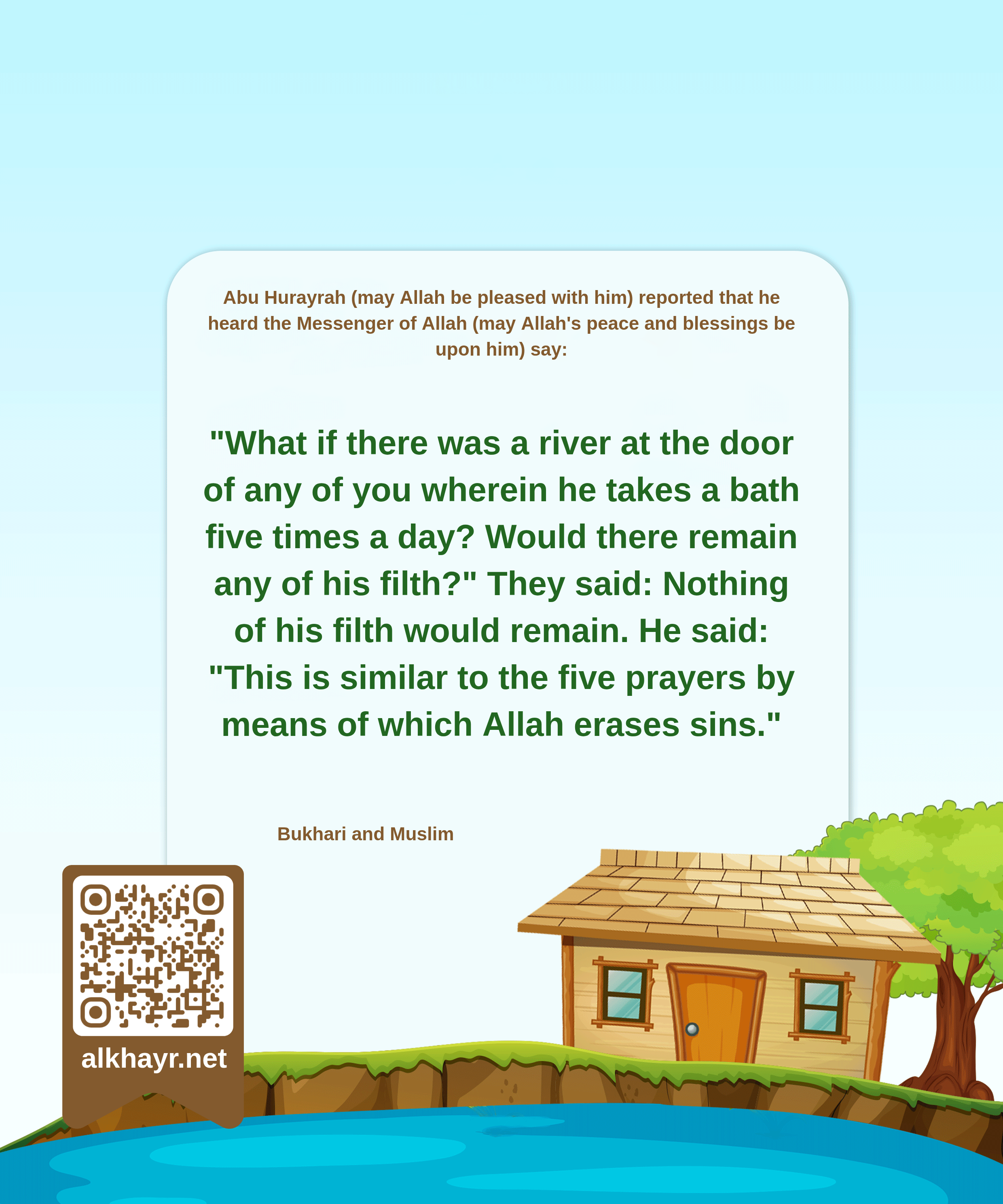
Abu Hurayrah (may Allah be pleased with him) reported that he heard the Messenger of Allah (may Allah's peace and blessings be upon him) say: "What if there was a river at the door of any of you wherein he takes a bath five times a day? Would there remain any of his filth?" They said: Nothing of his filth would remain. He said: "This is similar to the five prayers by means of which Allah erases sins."Agreed upon
‘Ā'ishah (may Allah be pleased with her) reported: During the lifetime of the Messenger of Allah (may Allah's peace and blessings be upon him) the sun eclipsed, so he led the people in prayer. He stood for a long time and then bowed for a long time. He stood again for a long time, but this time the period of standing was shorter than the first time. He then bowed again for a long time, but it was shorter than the first time, and then he prostrated and prolonged the prostration. He did the same in the second Rak‘ah and then finished the prayer. By that time, the sun had appeared. He delivered a sermon to the people and, after praising and glorifying Allah, he said: "The sun and the moon are two of the signs of Allah; they do not eclipse on the death or life of anyone. So when you see that, supplicate to Allah, say Takbīr, pray, and give charity." Then he said: "O followers of Muhammad, by Allah! No one gets more jealously protective than Allah when His male or female servant commits adultery. O followers of Muhammad, by Allah! If you knew what I know, you would laugh a little and weep a lot." The wording of another narration reads: "He completed bowing four times and four prostrations."Narrated by Bukhari & Muslim

‘Ā'ishah (may Allah be pleased with her) reported: 'At every part of the night, the Messenger of Allah (may Allah's peace and blessings be upon him) prayed Witr: at its beginning, middle, and end. Finally he settled on performing Witr just before dawn.Narrated by Bukhari & Muslim
‘Amr ibn Shu‘ayb reported from his father on the authority of his grandfather that the Messenger of Allah (may Allah's peace and blessings be upon him) said: "Command your children to pray when they are seven years old, and beat them for (not offering) it when they are ten, and separate them (boys and girls) in beds."Narrated by Abu Dāwūd
‘Abdullāh ibn Zayd ibn ‘Āsim al-Māzini (may Allah be pleased with him) reported: The Messenger of Allah (may Allah's peace and blessings be upon him) went out to invoke Allah for rain. He faced the direction of Qiblah as he invoked Allah, and turned his upper garment inside out. Then he prayed two Rak‘ahs and recited the Qur'an out loud in them. In another wording: "...facing the place of praying."Narrated by Bukhari & Muslim
‘Abdullāh ibn ‘Amr ibn al-‘Ās (may Allah be pleased with him) reported that the Prophet (may Allah's peace and blessings be upon him) said: "Eat, drink, give charity, and wear clothes without extravagance or pride."Narrated by Ibn Majah - Al-Bukhari as Mu‘allaq/hanging, with a decisive form - Narrated by Ahmad
‘Ā’ishah (may Allah be pleased with her) reported: The Prophet (may Allah’s peace and blessings be upon him) said: "Do not curse the dead, for they have reached the result of what they have done."Narrated by Al-Bukhāri
‘Abdur-Rahmān ibn Abi Layla reported: I came across Ka‘b ibn ‘Ujrah who said: Shall I offer you a present? The Prophet (may Allah's peace and blessings be upon him) came out to us, and we said: O Messenger of Allah, we have learned how to greet you, but how should we invoke the blessings of Allah upon you? He said: "Say: Allāhumma salli ‘ala Muhammad wa ‘ala āli Muhammad kama sallayta ‘ala āli Ibrāhīm innaka hamīdun majīd. Allāhumma bārik' ala Muhammad wa' ala āli Muhammad kama bārakta' ala āli Ibrāhīm innaka hamīdun majīd (O Allah, bestow Your grace upon Muhammad and the family of Muhammad just as You bestowed Your grace upon the family of Abraham. Verily, You are Praiseworthy, All-Glorious. O Allah, bless Muhammad and the family of Muhammad just as You blessed the family of Abraham. Verily, You are Praiseworthy, All-Glorious)."Agreed upon
‘Ubādah ibn as-Sāmit (may Allah be pleased with him) reported that the Messenger of Allah (may Allah's peace and blessings be upon him) said: "The prayer of the one who did not recite the Opening of the Book (Surat al-Fātihah) is invalid."Agreed upon
Anas ibn Mālik (may Allah be pleased with him) reported: I have never prayed behind an Imām who was more brief and more perfect in prayer than the Prophet (may Allah's peace and blessings be upon him).Narrated by Bukhari & Muslim
Abu Hurayrah (may Allah be pleased with him) reported: “The Messenger of Allah (may Allah's peace and blessings be upon him) said: "Whoever attends a funeral until he offers the funeral prayer will get a reward equal to one Qirāt; and whoever attends it until the dead person is buried will get a reward equal to two Qirāts." It was asked: "What are the two Qirāts?" He replied: "Like two huge mountains." In a narration by Muslim: “The smallest of them is like Mount Uhud.”Narrated by Bukhari & Muslim
Jundub ibn ‘Abdullāh al-Bajali (may Allah be pleased with him) reported that the Messenger (may Allah's peace and blessings be upon him) prayed on the Day of Nahr, then delivered a sermon, then slaughtered (an animal) and said: "Whoever slaughtered before praying should slaughter another animal instead, and whoever has not yet slaughtered should slaughter while mentioning Allah's name."Narrated by Bukhari & Muslim
Jundub ibn ‘Abdullāh al-Qasri (may Allah be pleased with him) reported: The Messenger of Allah (may Allah's peace and blessings be upon him) said: "Whoever performs the Fajr prayer is under the protection of Allah; so, do not infringe upon Allah's protection in any respect, for whoever infringes upon Allah's protection in any respect, He will seize him and throw him on his face in Hellfire."Narrated by Muslim
Abu Hurayrah (may Allah be pleased with him) reported that the Prophet (may Allah's peace and blessings be upon him) said: "Whoever goes to the mosque in the morning or the evening, Allah has prepared an abode for him in Paradise every time he goes in the morning or the evening."Agreed upon
‘Umar ibn al-Khattāb (may Allah be pleased with him) reported that the Prophet (may Allah's peace and blessings be upon him) said: "Whoever sleeps and fails to recite his nightly portion, or part of it, and then recites it between the Fajr prayer and the Zhuhr prayer, it will be recorded for him as if he recited it during the night."Narrated by Muslim