Hadith for the World
Virtues and Manners

Jurisprudence of Supplications and Remembrance of Allah

62 hadiths

62 hadiths

Abu Mūsa (may Allah be pleased with him) reported that the Prophet (may Allah's peace and blessings be upon him) used to invoke Allah with this supplication: "O Lord, forgive me my sin, my ignorance, my excess in all of my affairs, and whatever You are better aware of than me. O Allah, forgive me my sins, my deliberate sins, my ignorant sins, my humorous sins, and all of this I have committed. O Allah, forgive what I have done and what I have left undone, what I have committed secretly and what I have committed openly; You are the Advancer and You are the Delayer, and You have absolute power over everything."Agreed upon
Ibn ‘Umar (may Allah be pleased with him and his father) reported: The Messenger of Allah (may Allah's peace and blessings be upon him) never abandoned these supplications in the evening and the morning: "O Allah, I ask You for well-being in this world and the Hereafter. O Allah, I ask You for pardon and well-being in my religion, my worldly life, my family, and my wealth. O Allah, conceal my imperfection—or  my imperfections—and secure my fears. O Allah, protect me from before me, from behind me, from my right, from my left, and from above me, and I seek refuge with Your greatness from being suddenly killed from beneath me."Narrated by Abu Dāwūd, An-Nasā’i, Ibn Mājah, and Ahmad
‘Abdullah ibn ‘Umar (may Allah be pleased with him and his father) reported: The Messenger of Allah (may Allah's peace and blessings be upon him) used to supplicate, saying: "O Allah, I seek refuge with You from the removal of Your favor, the change of Your well-being, the suddenness of Your calamity, and all of Your wrath."Narrated by Muslim
‘Abdullah ibn ‘Amr ibn al-‘Ās (may Allah be pleased with him and his father) reported that the Messenger of Allah (may Allah's peace and blessings be upon him) used to supplicate with these words: "O Allah, I seek refuge with You from the dominance of debt, the dominance of the enemy, and the gloat of the enemies."Narrated by An-Nasā’i and Ahmad
Anas (may Allah be pleased with him) reported The supplication that the Prophet (may Allah's peace and blessings be upon him) recited most was: "Allāhumma rabbana ātina fi ad-dunya hasanah wa fi al-ākhirati hasanah wa qina ‘adhāb an-nār (O Allah our Lord, give us in this world that which is good and in the Hereafter that which is good and protect us from the torment of the Fire)."Agreed upon
Shaddād ibn Aws (may Allah be pleased with him) reported from the Prophet (may Allah's peace and blessings be upon him): "The best way of seeking Allah's forgiveness is to say: 'Allāhumma anta rabbi la ilāha illa ant khalaqtani wa ana ‘abduk wa ana ‘ala ‘ahdika wa wa‘dika mastata‘t a‘ūdhu bika min sharri ma sana‘t abū’u laka bini‘matika ‘alayya wa abū’u bidhanbi faghfir li fa innahu la yaghfiru adh-dhunūba illa ant (O Allah, You are my Lord. You created me, and I am Your slave. I will remain faithful to Your covenant and promise as much as possible. I seek refuge with You from the evil of what I have done. I acknowledge Your favor upon me, and I admit my sin. So, forgive me. Indeed, none can forgive sins but You).'" He (may Allah's peace and blessings be upon him) added: "And whoever says this during the day while being certain of its meaning, then he dies before the evening, he will be from the people of Paradise, and whoever says it at night while being certain of its meaning then he dies before the morning, he will be from the people of Paradise."Narrated by Al-Bukhāri
Abu Hurayrah (may Allah be pleased with him) reported: The Prophet (may Allah's peace and blessings be upon him) said: "There are two words that are light on the tongue, heavy on the scale, and dear to the Most Merciful: subhān Allah al-‘azhīm (glory be to Allah, the Majestic), subhān Allah wa bihamdih (glory and praise be to Allah)."Agreed upon
Zayd ibn Arqam (may Allah be pleased with him) reported: I only say to you what the Messenger of Allah (may Allah's peace and blessings be upon him) used to say. He used to say: "Allāhumma inni a‘ūdhu bika min al-‘ajzi wal-kasal, wal-jubni wal-bukhl, wal-harami wa ‘adhāb al-qabr. Allāhumma āti nafsi taqwāha, wa zakkiha anta khayru man zakkāha, anta waliyyuha wa mawlāha. Allāhumma inni a‘ūdhu bika min ‘ilmin la yanfa‘, wa min qalbin la yakhsha‘, wa min nafsin la tashba‘, wa min da‘watin la yustajābu laha" (O Allah, I seek refuge with You from inability, indolence, cowardice, miserliness, decrepitude, and torment of the grave. O Allah, grant me the sense of piety and purify my soul as You are the Best to purify it. You are its Protector and its Guardian. O Allah, I seek refuge with You from knowledge that is not beneficial, from a heart that does not fear, from a soul that is not satisfied, and from a supplication that is not answered).Narrated by Muslim

Anas ibn Mālik (may Allah be pleased with him) reported that the Prophet (may Allah's peace and blessings be upon him) said: ''Praise be to Allah Who gave us food and drink, provided for us sufficiently, and gave us shelter, for how many there are who have no one to provide for them or to give them shelter.''Narrated by Muslim
Abu Hurayrah (may Allah be pleased with him) reported that the Prophet (may Allah's peace and blessings be upon him) used to say: "O Allah, I seek refuge in You from hunger, for it is an evil bed-fellow, and I seek refuge in You from treachery, for it is an evil hidden trait."Narrated by Ibn Majah - An-Nasaa’i - Narrated by Abu Daoud
Anas ibn Mālik (may Allah be pleased with him) reported: The Messenger of Allah (may Allah's peace and blessings be upon him) used to say: "O Allah, I seek refuge with You from incapacity, laziness, cowardice, senility, and miserliness. And I seek refuge with You from the torment of the grave. And I seek refuge with You from the trials of life and death." Another narration adds: "... and from the burden of heavy debt and the tyranny of men."Narrated by Bukhari - Narrated by Bukhari & Muslim
‘Ali (may Allah be pleased with him) reported: The Messenger of Allah (may Allah's peace and blessings be upon him) said to me: "Say: O Allah, guide me and make me adhere to the straight path, and when asking for Huda (guidance), think of your being guided to the right path, and Sadād (adherence to the straight path) is the straightness of the arrow."Narrated by Muslim
Khawlah bint Hakīm (may Allah be pleased with her) reported: I heard the Messenger of Allah (may Allah's peace and blessings be upon him) say: "Whoever alights somewhere and then says: '‘A‘ūdhu bi kalimātillāh at-tāmmāti min sharri ma khalaq (I seek refuge in the perfect words of Allah from the evil of what He has created)', nothing will harm him until he leaves that place."Narrated by Muslim
Abu Hurayrah (may Allah be pleased with him) reported that the Prophet (may Allah's peace and blessings be upon him) said: "When any one of you goes to his bed, let him dust off his bed with the end of his lower garment, for indeed he does not know what came unto it after he had left it. Then one should say: 'In Your Name, O my Lord, I place my side (on the bed), and by You I will lift it. If You take my soul, then have mercy on it, and if You send it, then protect it as You protect Your righteous slaves.'"Narrated by Bukhari & Muslim
Abu Hurayrah (may Allah be pleased with him) reported that the Prophet (may Allah's peace and blessings be upon him) said: "Seek refuge with Allah from arduous afflictions, degrading misery, preordained evils, and from the gloating of enemies." In another narration, Sufyān said: "I suspect that I added one of them."Narrated by Bukhari & Muslim
Anas ibn Mālik (may Allah be pleased with him) reported that the Prophet (may Allah's peace and blessings be upon him) used to say: "O Allah, I seek refuge in You from leucoderma, insanity, leprosy, and evil diseases."An-Nasaa’i - Narrated by Abu Daoud - Narrated by Ahmad
‘Abdullah ibn Khubayb (may Allah be pleased with him) reported: We went out on a rainy and extremely dark night looking for the Messenger of Allah (may Allah's peace and blessings be upon him) to lead us in prayer. He said: I caught up with him, and he said: "Say," but I did not say anything. Then, he said: "Say," and again, I said nothing. He said: "Say." I replied: What should I say? He said: "{Say: "He is Allah, the One"} and Al-Mu'awwidhatān (Surat al-Falaq and Surat an-Nās) thrice in the evening and the morning, they will grant you protection from everything."Narrated by Abu Dāwūd, At-Tirmidhi, and An-Nasā’i
Talhah Ibn ‘Ubaydulllāh (may Allah be pleased with him) reported: On sighting the new moon, the Prophet (may Allah's peace and blessings be upon him) would say: "O Allah, let this new moon appear on us with security and faith, and with safety and Islam. (O moon) Your Lord and my Lord is Allah. May this new moon be a carrier of guidance and good!"Ibn Abi Shaybah - Narrated by At-Termedhy - Narrated by Ahmad - Ad-Daarimi
Jābir (may Allah be pleased with him) reported: When we ascended (a high land), we used to say Takbīr, and when we descended, we used to say Tasbīh. Ibn ‘Umar (may Allah be pleased with him) reported: When the Prophet (may Allah's peace and blessings be upon him) and his armies, ascended hills, they would say Takbīr, and when they descended, they would say Tasbīh.Narrated by Bukhari - Narrated by Abu Daoud
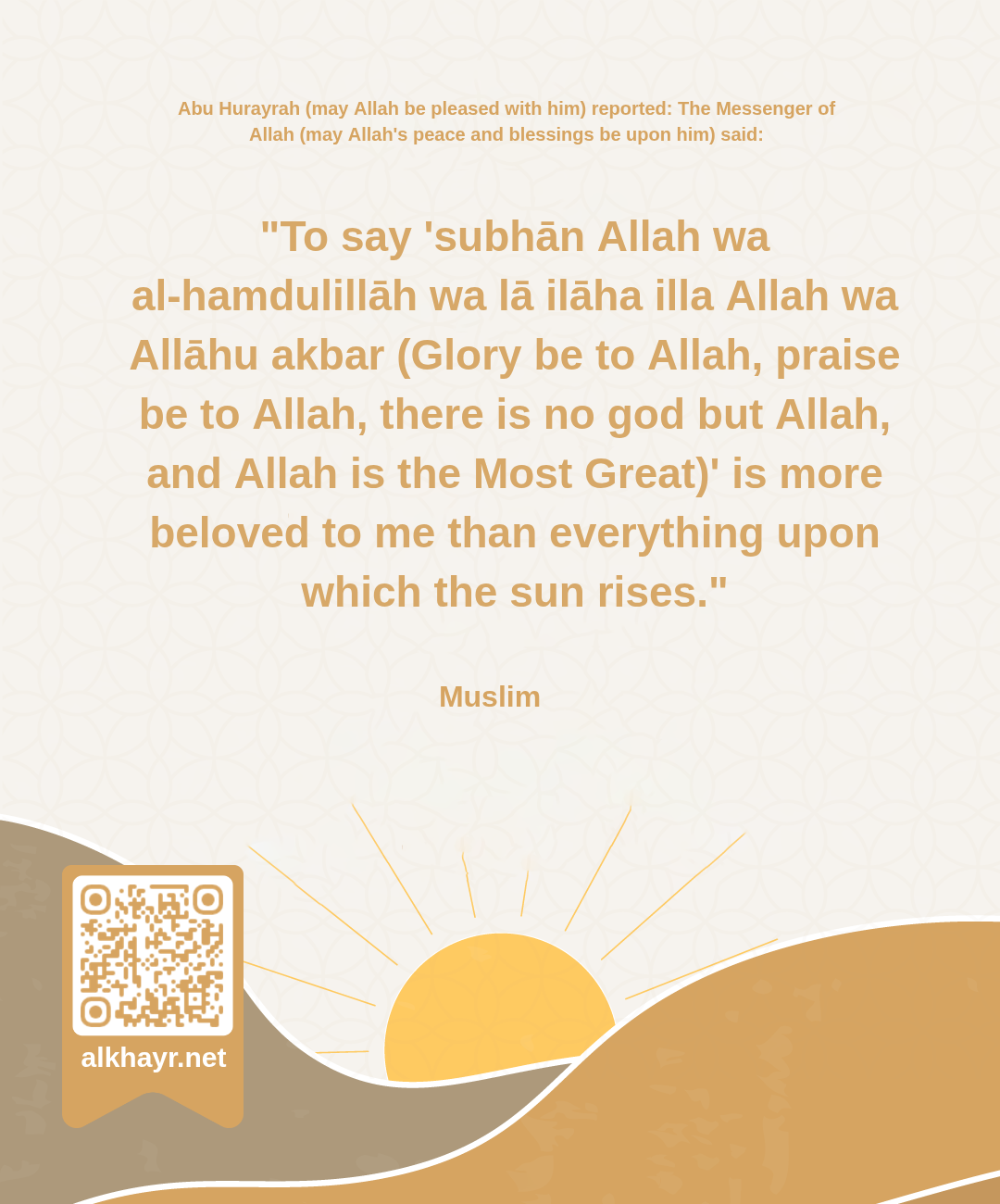
Abu Hurayrah (may Allah be pleased with him) reported: The Messenger of Allah (may Allah's peace and blessings be upon him) said: "To say 'subhān Allah wa al-hamdulillāh wa lā ilāha illa Allah wa Allāhu akbar (Glory be to Allah, praise be to Allah, there is no god but Allah, and Allah is the Most Great)' is more beloved to me than everything upon which the sun rises."Narrated by Muslim
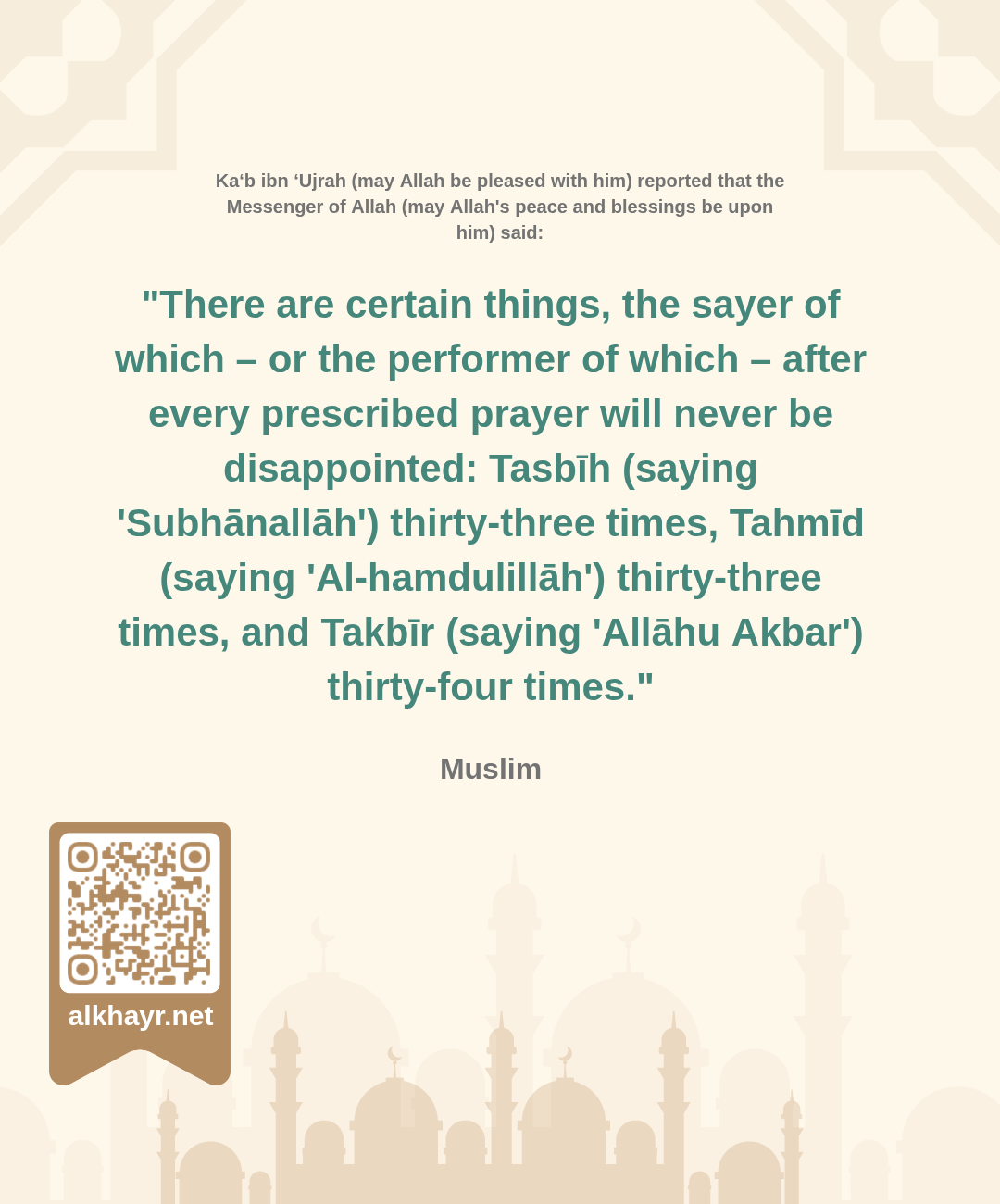
Ka‘b ibn ‘Ujrah (may Allah be pleased with him) reported that the Messenger of Allah (may Allah's peace and blessings be upon him) said: "There are certain things, the sayer of which – or the performer of which – after every prescribed prayer will never be disappointed: Tasbīh (saying 'Subhānallāh') thirty-three times, Tahmīd (saying 'Al-hamdulillāh') thirty-three times, and Takbīr (saying 'Allāhu Akbar') thirty-four times."Narrated by Muslim
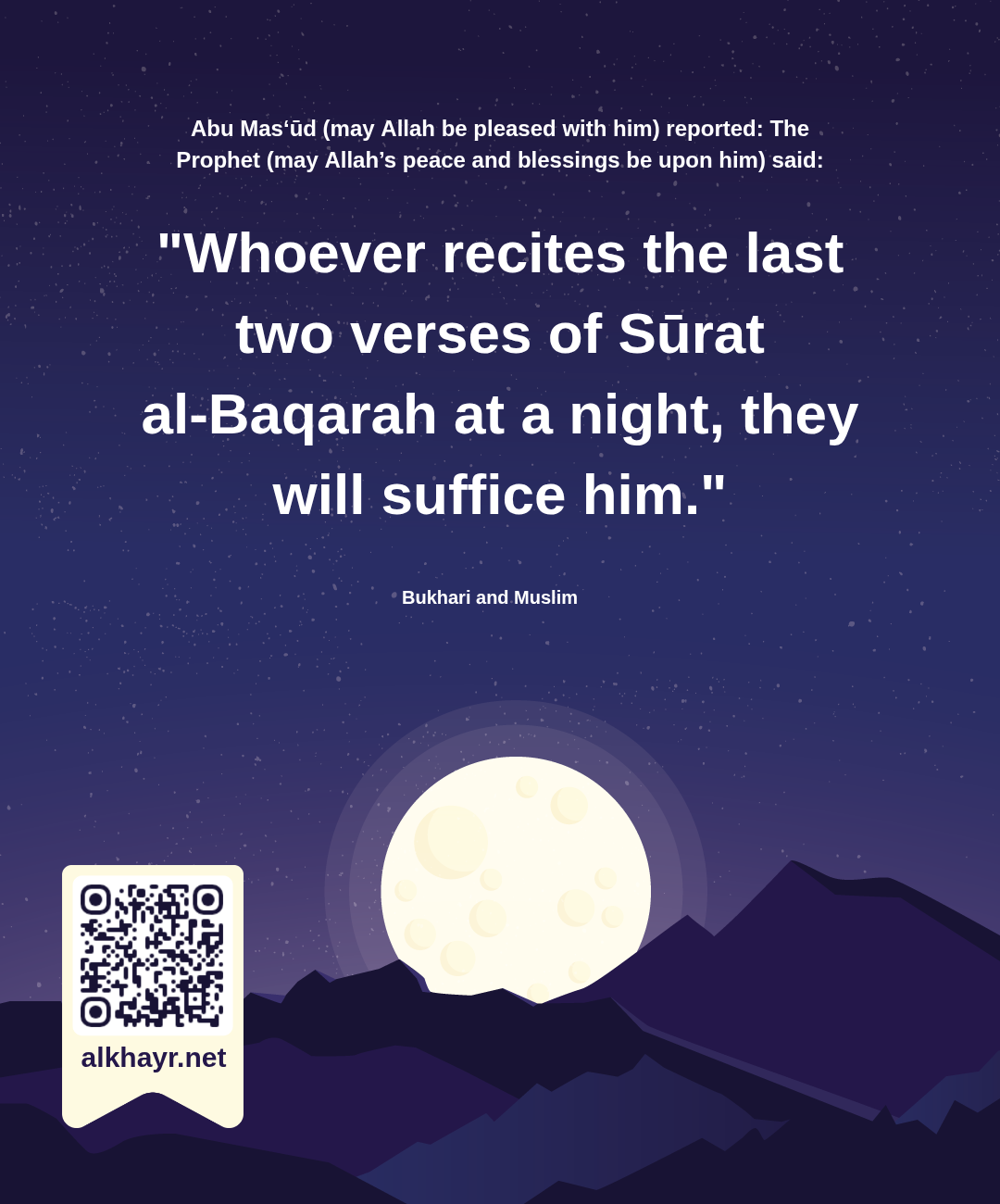
Abu Mas‘ūd (may Allah be pleased with him) reported: The Prophet (may Allah’s peace and blessings be upon him) said: "Whoever recites the last two verses of Sūrat al-Baqarah at a night, they will suffice him."Agreed upon
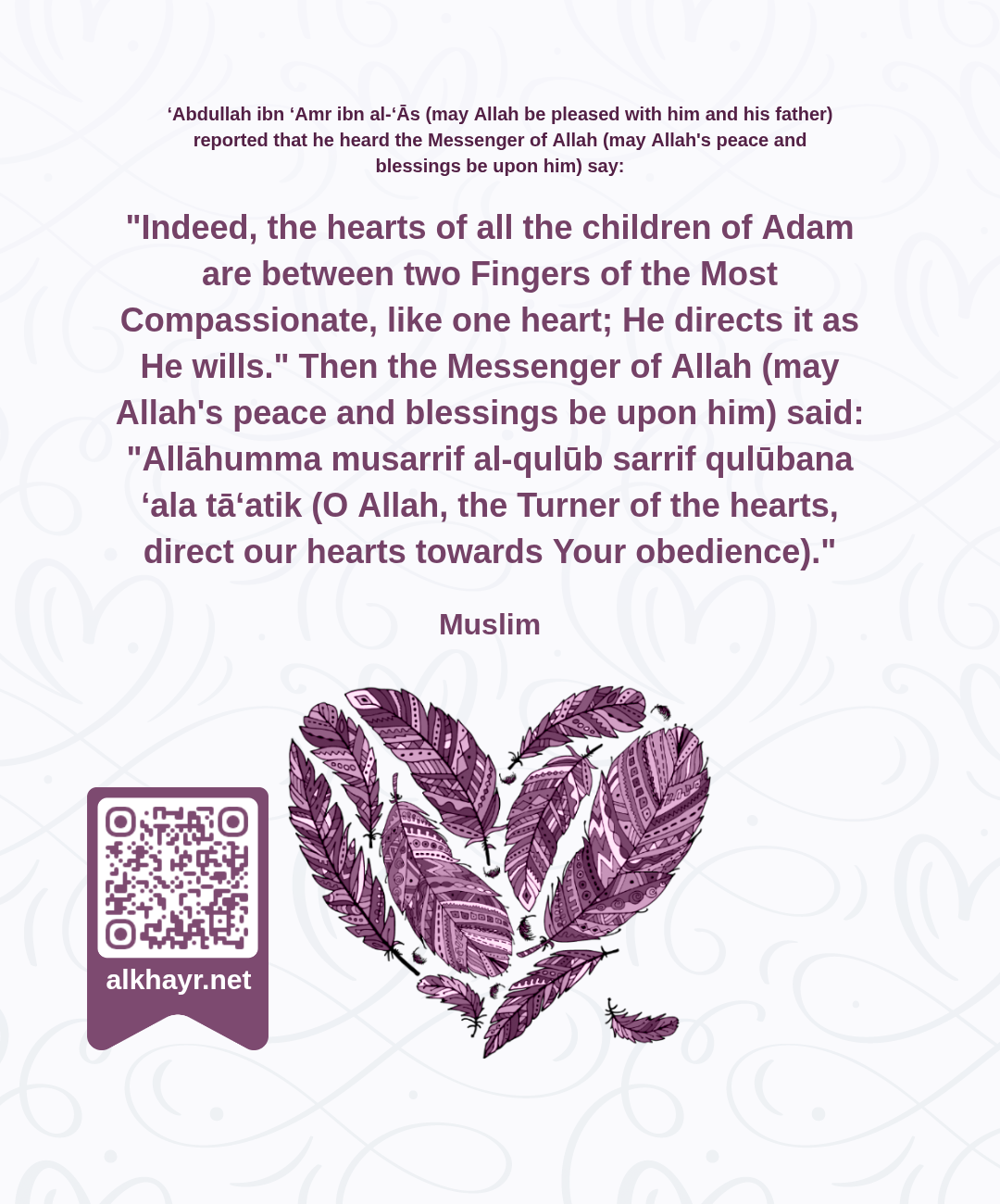
‘Abdullah ibn ‘Amr ibn al-‘Ās (may Allah be pleased with him and his father) reported that he heard the Messenger of Allah (may Allah's peace and blessings be upon him) say: "Indeed, the hearts of all the children of Adam are between two Fingers of the Most Compassionate, like one heart; He directs it as He wills." Then the Messenger of Allah (may Allah's peace and blessings be upon him) said: "Allāhumma musarrif al-qulūb sarrif qulūbana ‘ala tā‘atik (O Allah, the Turner of the hearts, direct our hearts towards Your obedience)."Narrated by Muslim
‘Abdullāh ibn ‘Amr ibn al-‘Ās (may Allah be pleased with him) reported: When the Prophet (may Allah's peace and blessings be upon him) entered the mosque, he would say: "a‘ūdhu billāhi al-‘azhīm wa biwajhihi al-karīm wa sultānihi al-qadīm min ash-shaytān ar-rajīm" (I seek refuge in Allah, the Majestic, and in His noble Countenance, and in His eternal dominion, from the accursed devil) He said: "Is that all?" I said: 'Yes.' He said: "And when he says that, the devil says: "He is protected from me for the rest of the day."Narrated by Abu Dāwūd