EN
Jurisprudence and Juristic Principles
Jurisprudence of Acts of Worship
231 hadiths
Purification
18
Prayer
126
Funerals
11
Zakah
13
Fasting
40
Hajj and ‘Umrah
17
Jihad
17
231 hadiths
‘Uqbah ibn ‘Āmir al-Juhani (may Allah be pleased with him) reported: Three hours the Messenger of Allah (may Allah's peace and blessings be upon him) used to forbid us from praying or burying our deceased ones in them: when the sun begins to rise until it has fully risen; when the sun is at its zenith until it begins to decline; and when the sun starts setting until it has fully set.
Narrated by Muslim
Jubayr ibn Mut‘im (may Allah be pleased with him) reported that the Prophet (may Allah's peace and blessings be upon him) said: "Do not prevent anyone from circumambulating this House and from praying at any time of the day or night as they wish."
Narrated by Ibn Majah - Narrated by At-Termedhy - An-Nasaa’i - Narrated by Abu Daoud - Narrated by Ahmad - Ad-Daarimi
Jābir ibn ‘Abdullah (may Allah be pleased with him and his father) reported that the Messenger of Allah (may Allah's peace and blessings be upon him) said: "Whoever says upon hearing the call: O Allah, Lord of this perfect call and the prayer that is to be established, grant Muhammad Al-Wasīlah and Al-Fadīlah and resurrect him to the Praiseworthy Station that You have promised him, he will be granted my intercession on the Day of Judgment."
Narrated by Al-Bukhāri
Abu Marthad al-Ghanawi (may Allah be pleased with him) reported: The Messenger of Allah (may Allah's peace and blessings be upon him) said: "Do not sit on graves, and do not pray towards them."
Narrated by Muslim
‘Abdullāh ibn Ash-Shikhkhīr (may Allah be pleased with him) reported: I saw the Messenger of Allah (may Allah's peace and blessings be upon him) praying and making a sound like the rumbling of a mill because of weeping.
An-Nasaa’i - Narrated by Abu Daoud - Narrated by Ahmad
Anas ibn Mālik (may Allah be pleased with him) reported that the Messenger of Allah (may Allah's peace and blessings be upon him) said: "If the supper is served, then start eating it before praying the Maghrib prayer, and do not be hasty in finishing it."
Narrated by Bukhari & Muslim
Anas ibn Mālik (may Allah be pleased with him) reported that the Prophet (may Allah's peace and blessings be upon him) saw mucus in the prayer's direction. That was difficult for him to bear, and the feeling was even reflected in his face. Therefore, he stood up and scratched the mucus with his hand and said: "When one of you stands to pray, he is privately conversing with his Lord, or his Lord is between him and the prayer direction. So let no one of you spit in the direction of prayer, but only to his left or under his feet." Then he took a corner of his garment, spat into it, folded it up, and said: "Or he should do like this."
Narrated by Bukhari & Muslim
Anas ibn Mālik (may Allah be pleased with him) reported: The Prophet (may Allah's peace and blessings be upon him) said: "What is the matter with some people who raise their eyes towards the sky during their prayer?" He went on, using strict words, until he said, "They must stop that, or their eyesight will be snatched away."
Narrated by Al-Bukhāri
‘Ā’ishah, the Mother of the Believers, (may Allah be pleased with her) reported: ’Umm Salamah mentioned to the Messenger of Allah (may Allah's peace and blessings be upon him) that she had seen a church in Abyssinia called Māriyah, and she mentioned the images that she had seen therein. The Messenger of Allah (may Allah's peace and blessings be upon him) said: "Those are a people who, when a righteous slave or a righteous man from among them dies, they build a place of worship over his grave and place those images therein. Those are the most evil people in the sight of Allah."
Agreed upon
Ibn ‘Abbās (may Allah be pleased with him) reported: The Messenger of Allah (may Allah's peace and blessings be upon him) drew the curtain (of his chamber) aside to see the people standing in rows behind Abu Bakr in prayer. He then said: "O people, there is nothing remaining of the glad tidings of prophet-hood except a good vision that a Muslim sees or someone else sees it for him. Verily, I have been forbidden to recite the Qur'an while bowing or prostrating. So, while bowing, glorify the Lord, and while prostrating, engage in supplication diligently, for it is most likely that your supplications would be answered."
Narrated by Muslim
Al-Hakam reported: Kufah was conquered by a man called Zamān ibn al-Ash‘ath. He ordered Abu ‘Ubaydah ibn ‘Abdullāh to lead people in prayer. When he performed the prayer, he would rise from bowing and stand for as long it took me to say: "O Allah, our Lord, to You is all praise that fills the heavens and earth and whatever You will beyond that. All praise and glory belong to You. No one can withhold what You have given and no one can give what You have withheld. And the good fortune of a person will not avail him before You." Al-Hakam added: "I mentioned this to ‘Abdur-Rahmān ibn Abu Layla and he said: ‘I head Al-Barā' ibn ‘Āzib say: 'In the prayer of the Messenger of Allah (may Allah's peace and blessings be upon him), the bowing, rising from bowing, prostration, and sitting between the two prostrations were all roughly the same (in length).''' Shu‘bah said: "I related this to ‘Amr ibn Murrah and he said: ‘I saw Ibn Abu Layla, and his prayer was not like that.'"
Narrated by Muslim
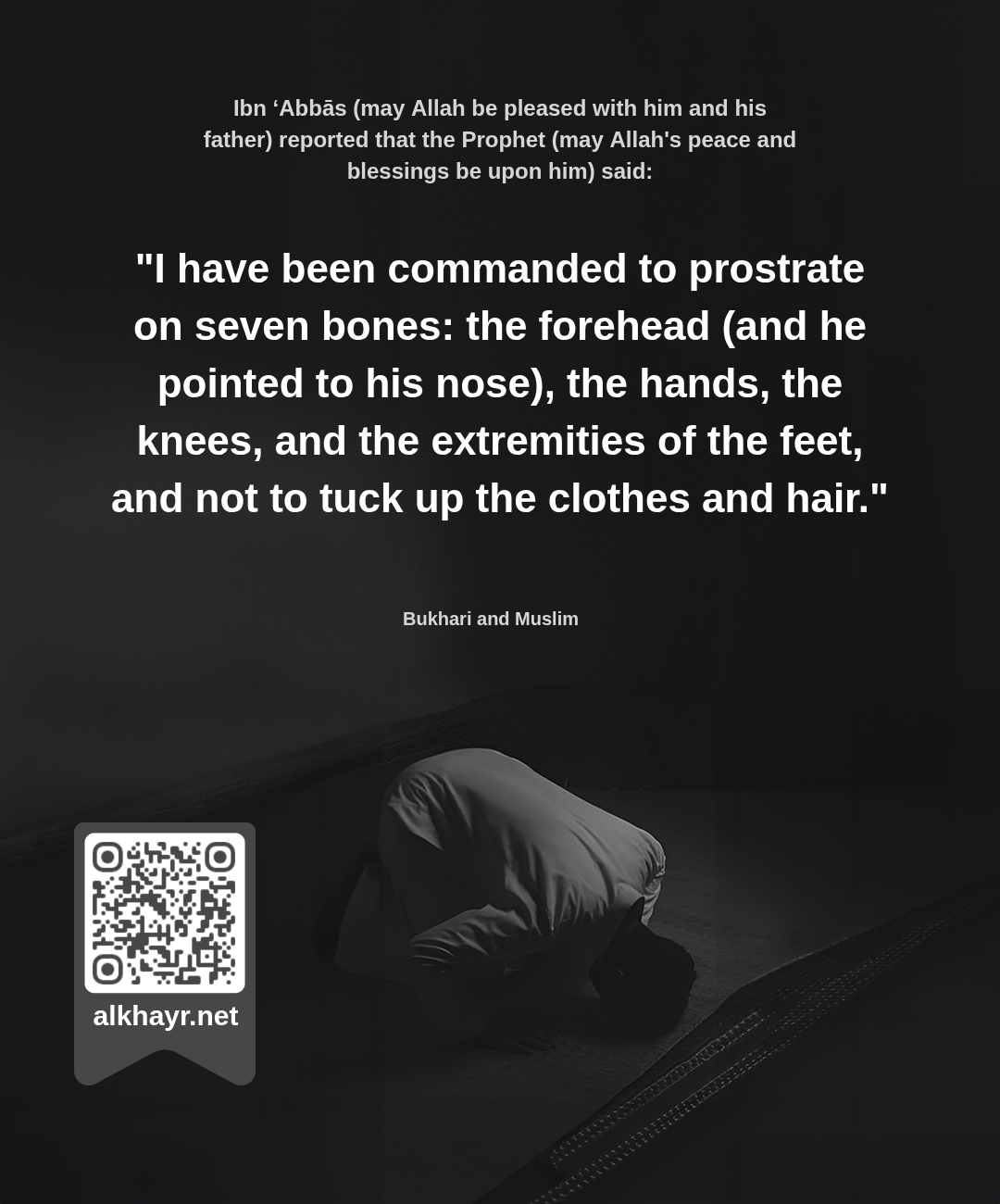
Ibn ‘Abbās (may Allah be pleased with him and his father) reported that the Prophet (may Allah's peace and blessings be upon him) said: "I have been commanded to prostrate on seven bones: the forehead (and he pointed to his nose), the hands, the knees, and the extremities of the feet, and not to tuck up the clothes and hair."
Agreed upon
Ibn ‘Abbās (may Allah be pleased with him) reported: The Prophet (may Allah's peace and blessings be upon him) used to say between the two prostrations: "Allahumma ighfir li warhamni wa ‘āfeni wahdeni warzuqni (O Allah, forgive me, have mercy on me, grant me safety, guide me, and provide for me)".
Narrated by Abu Dāwūd, At-Tirmidhi, Ibn Mājah, and Ahmad
Anas ibn Mālik (may Allah be pleased with him) reported that the Prophet (may Allah's peace and blessings be upon him) did not say the Qunūt but he would pray for welfare of a people or doom of others.
Ibn Khuzaymah
Thawbān (may Allah be pleased with him) reported: When the Messenger of Allah (may Allah's peace and blessings be upon him) finished his prayer, he would seek Allah’s forgiveness three times and say: "Allahumma anta as-salām wa minka as-salām, tabārakta yadha al-jalāl wa al-ikrām (O Allah, You are As-Salām (peace, perfection), and as-salām comes from You. Blessed are You, O Possessor of Glory and Honor)". Al-Walīd said: I said to Al-Awzā‘i: "How is the seeking of forgiveness?" He said: "You say: Astaghfirullāh, astaghfirullāh (I seek forgiveness from Allah, I seek forgiveness from Allah)."
Narrated by Muslim
Abu Hurayrah (may Allah be pleased with him) reported that the Messenger of Allah (may Allah's peace and blessings be upon him) said: "Whoever glorifies Allah directly after each prayer thirty-three times, praises Allah thirty-three times, and proclaims the greatness of Allah thirty-three times, these are ninety-nine, and completes one hundred by saying: La ilāha illallāh wahdahu la sharīka lah, lahu al-mulku wa lahu al-hamdu wa huwa ‘ala kulli shay’in qadīr (There is no god except Allah. He is One and has no partner with Him. To Him belongs sovereignty and to Him belongs praise, and He is Omnipotent over everything), his sins will be forgiven even if they are like the sea foam."
Narrated by Muslim
Abu ’Umāmah (may Allah be pleased with him) reported: The Messenger of Allah (may Allah's peace and blessings be upon him) said: "Whoever recites the Verse of the Kursi right after each obligatory prayer will have nothing preventing him from entering Paradise except that he dies."
Narrated by An-Nasā’i in Al-Kubra
‘Imrān ibn Husayn (may Allah be pleased with him) reported: I was suffering from hemorrhoids (piles); so I asked the Prophet (may Allah's peace and blessings be upon him) about the prayer and he said: "Pray while standing; if you cannot, then while sitting; and if you cannot, then while lying on your side."
Narrated by Al-Bukhāri
‘Ā'ishah (may Allah be pleased with her) reported: One night, the Prophet (may Allah's peace and blessings be upon him) performed Qiyām while reciting a single verse from the Qur'an (over and over again).
Narrated by At-Termedhy
Abu Sa‘īd al-Khudri (may Allah be pleased with him) reported: The Messenger of Allah (may Allah's peace and blessings be upon him) said: "When anyone of you is in doubt about his prayer, not knowing how much he prayed, three or four, let him dispel the doubt and build upon what he is certain about, then perform two prostrations before making Taslīm. If he has prayed five, they will make his prayer even-numbered, and if he has prayed exactly four, they will be humiliation for the devil."
Narrated by Muslim
Abu Rāfi‘ reported that Abu Hurayrah (may Allah be pleased with him) recited Sūrat al-Inshiqāq and then prostrated. After he finished the prostration, he told them that the Messenger of Allah (may Allah’s peace and blessings be upon him) had prostrated when he recited it.
Narrated by Bukhari & Muslim
Abu Bakrah reported: Whenever the Prophet (may Allah's peace and blessings be upon him) received good news, he would fall down in prostration out of gratitude to Allah.
Narrated by Ibn Majah - Narrated by At-Termedhy - Narrated by Abu Daoud - Narrated by Ahmad
Hafsah (may Allah be pleased with her) reported: The Prophet (may Allah's peace and blessings be upon him) used to pray two light Rak‘ahs after the break of dawn. Another narration reads: "before the (Fajr) prayer would start."
Narrated by Bukhari
‘Ā’ishah, Mother of the Believers, (may Allah be pleased with her) reported: The Prophet (may Allah's peace and blessings be upon him) did not ever leave four before Zhuhr and two Rak‘ahs before morning.
Narrated by Al-Bukhāri
Previous page
Page 7 of 10
Next page