EN
Jurisprudence and Juristic Principles
Jurisprudence of Acts of Worship
231 hadiths
Purification
18
Prayer
126
Funerals
11
Zakah
13
Fasting
40
Hajj and ‘Umrah
17
Jihad
17
231 hadiths
’Umm Habībah, the Prophet's wife, (may Allah be pleased with her) reported: I heard the Messenger of Allah (may Allah's peace and blessings be upon him) say: "Whoever regularly observes four Rak‘ahs before Zhuhr and four after it, Allah will make him forbidden to Hellfire."
Narrated by Abu Dāwūd, At-Tirmidhi, An-Nasā’i, Ibn Mājah, and Ahmad
‘Abdullāh ibn ‘Umar (may Allah be pleased with him) reported that the Messenger of Allah (may Allah's peace and blessings be upon him) said: "May Allah have mercy on whoever offers four Rak‘ahs before the ‘Asr prayer."
Narrated by At-Termedhy - Narrated by Abu Daoud - Narrated by Ahmad
‘Abdullāh ibn Mughaffal (may Allah be pleased with him) reported that the Messenger (may Allah's peace and blessings be upon him) said: "Offer two Rak‘ahs before Maghrib." Then he said: "Offer two Rak‘ahs before Maghrib, if you will," fearing people might take it as Sunnah.
Narrated by Bukhari
‘Ā'ishah (may Allah be pleased with her) reported: The Messenger of Allah (may Allah's peace and blessings be upon him) used to pray two light Rak‘ahs before the Fajr prayer, after the Muezzin would finish calling the Adhān and after the break of dawn. Then, he used to lie on his right side until the Muezzin would come to him for the Iqāmah.
Narrated by Bukhari & Muslim
‘Abdullah ibn ‘Umar (may Allah be pleased with him and his father) reported: A man asked the Prophet (ﷺ) while he was on the pulpit: What do you say about the night prayer? He (ﷺ) said: "Two by two (i.e., in sets of two Rak‘ahs). When he fears that dawn is approaching, he should pray one (Rak‘ah), which will make what he has prayed Witr (odd)." And he (ﷺ) used to say: "Make the last of your prayers at night Witr,” for the Prophet (ﷺ) commanded it.
Agreed upon
Ibn ‘Umar (may Allah be pleased with him) reported that the Prophet (may Allah's peace and blessings be upon him) said: "(Voluntary) prayer in both the day and night is performed two by two."
Narrated by Ibn Majah - Narrated by At-Termedhy - An-Nasaa’i - Narrated by Abu Daoud - Narrated by Ahmad
Abu Hurayrah (may Allah be pleased with him) reported that the Messenger of Allah (may Allah's peace and blessings be upon him) said: "The most excellent fast after Ramadan is Allah's month, Muharram, and the most excellent prayer after what is prescribed is prayer during the night."
Narrated by Muslim
Abu Ayyūb al-Ansāri (may Allah be pleased with him) reported that the Prophet (may Allah's peace and blessings be upon him) said: "The Witr is due, so whoever wants to pray the Witr as seven (units of prayer), let him do so; whoever wants to pray the Witr as five, let him do so; whoever wants to pray the Witr as three, let him do so; and whoever wants to pray the Witr as one, let him do so."
Narrated by Ibn Majah - An-Nasaa’i - Narrated by Abu Daoud
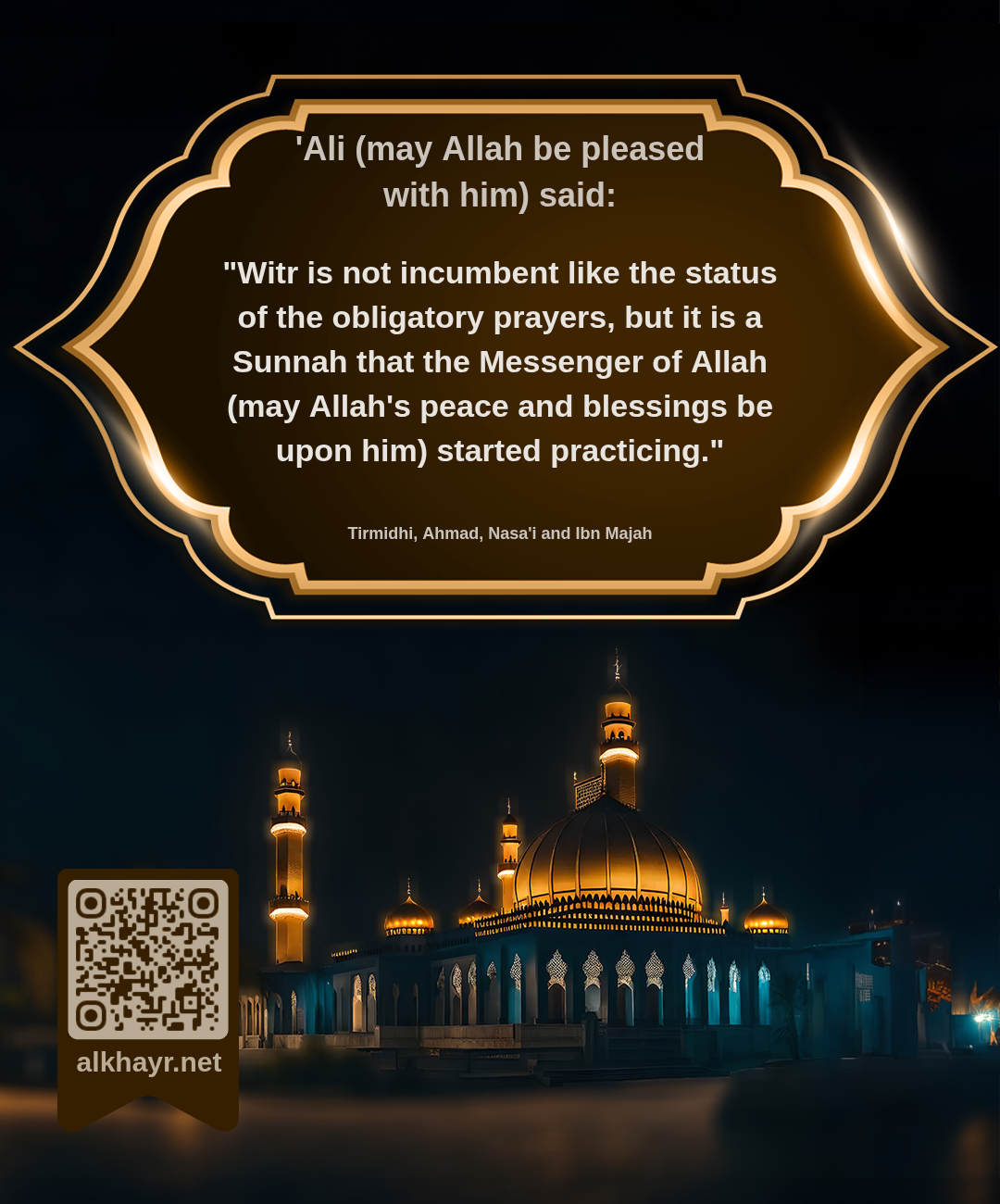
‘Ali (may Allah be pleased with him) said: "Witr is not incumbent like the status of the obligatory prayers, but it is a Sunnah that the Messenger of Allah (may Allah's peace and blessings be upon him) started practicing."
Narrated by Ibn Majah - Narrated by At-Termedhy - An-Nasaa’i - Narrated by Ahmad
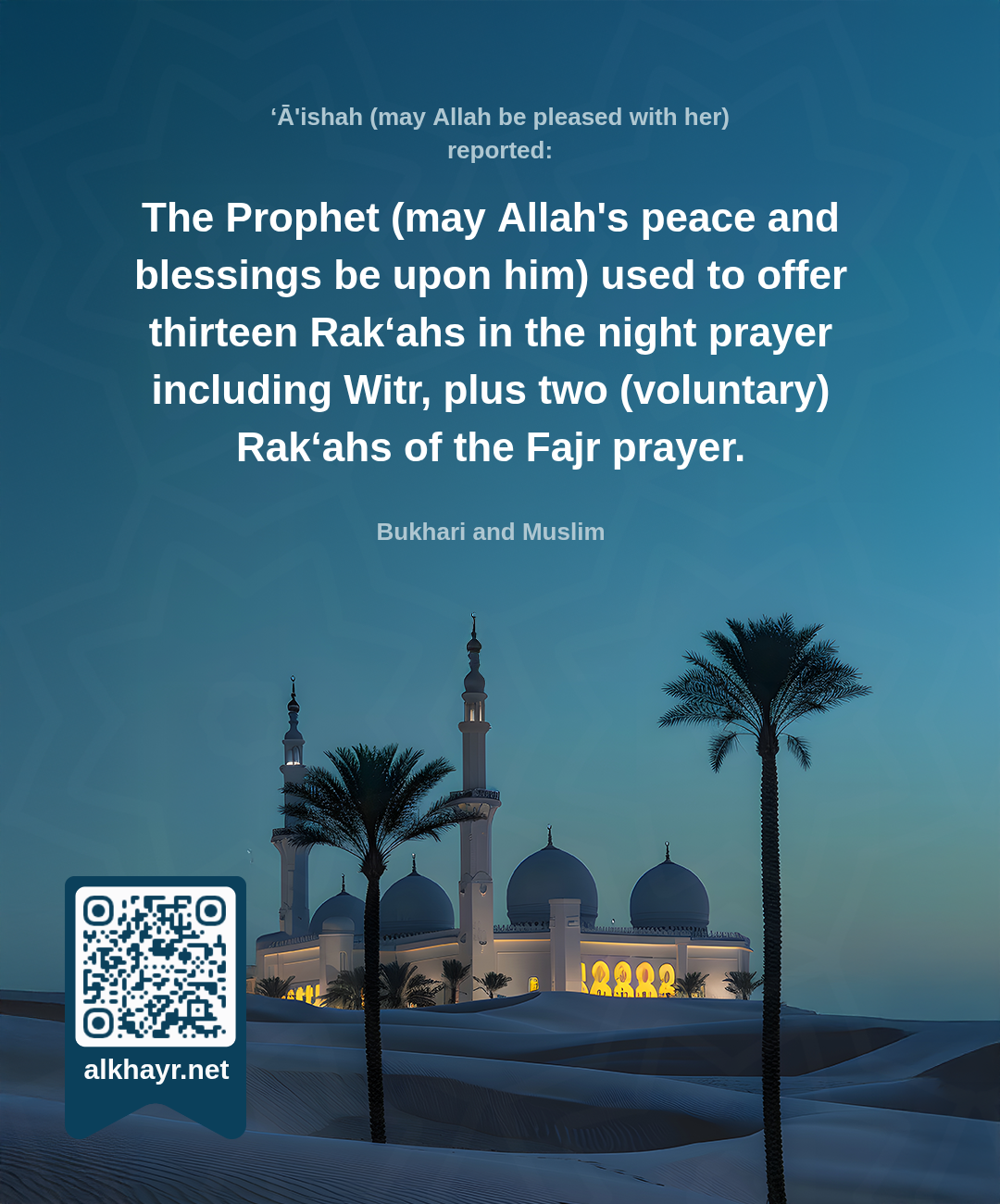
‘Ā'ishah (may Allah be pleased with her) reported: The Prophet (may Allah's peace and blessings be upon him) used to offer thirteen Rak‘ahs in the night prayer including Witr, plus two (voluntary) Rak‘ahs of the Fajr prayer.
Narrated by Bukhari & Muslim
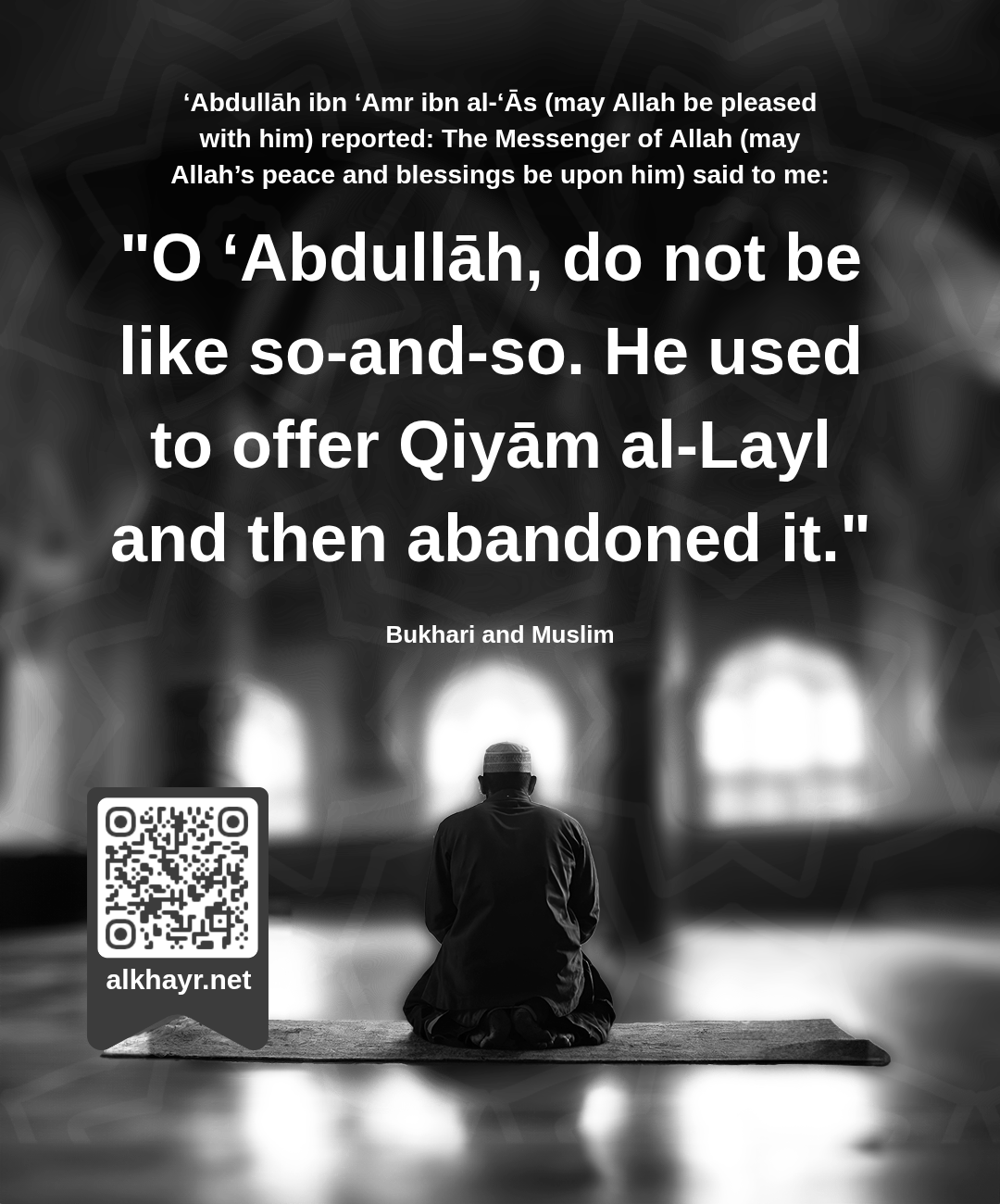
‘Abdullāh ibn ‘Amr ibn al-‘Ās (may Allah be pleased with him) reported: The Messenger of Allah (may Allah’s peace and blessings be upon him) said to me: "O ‘Abdullāh, do not be like so-and-so. He used to offer Qiyām al-Layl and then abandoned it."
Narrated by Bukhari & Muslim
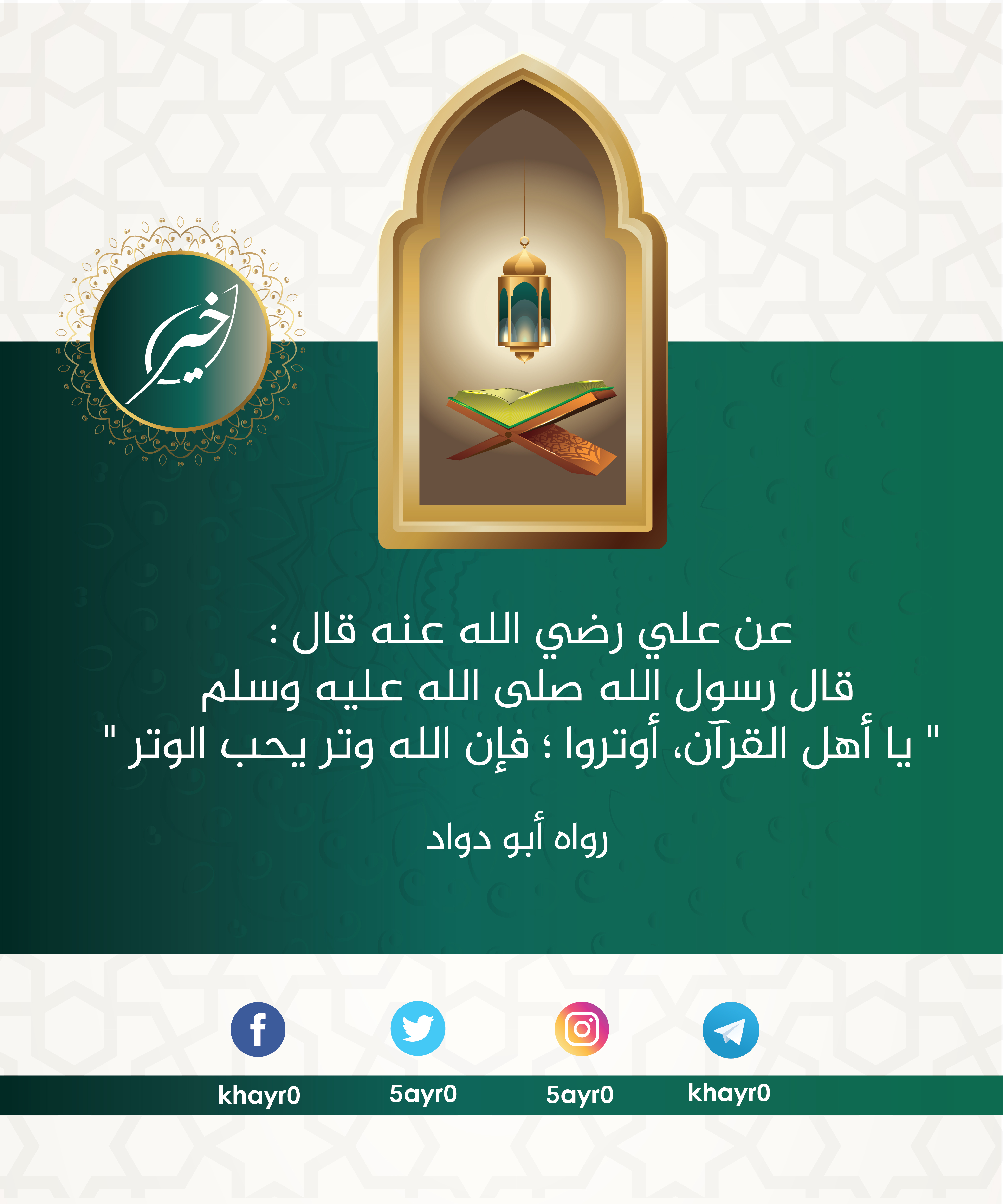
‘Ali (may Allah be pleased with him) reported: The Messenger of Allah (may Allah's peace and blessings be upon him) said: "O people of the Qur'an, perform the Witr Prayer for, verily, Allah is Witr (single) and loves what is Witr (single, odd)."
Narrated by Ibn Majah - Narrated by At-Termedhy - An-Nasaa’i - Narrated by Abu Daoud - Narrated by Ahmad
Abu Sa‘īd al-Khudri (may Allah be pleased with him) reported that the Prophet (may Allah's peace and blessings be upon him) said: "Perform Witr prayer before the morning."
Narrated by Muslim
Abu Sa‘īd al-Khudri (may Allah be pleased with him) reported the Prophet (may Allah's peace and blessings be upon him) said: "If anyone sleeps before praying Witr or forgets it, let him pray it once he remembers it."
Narrated by Ibn Majah - Narrated by At-Termedhy - Narrated by Abu Daoud - Narrated by Ahmad
Jābir (may Allah be pleased with him) reported that the Messenger of Allah (may Allah's peace and blessings be upon him) said: "If anyone fears that he will not wake up at the end of the night, let him offer Witr prayer at the beginning of the night; and anyone expects to wake up at the end of the night, let him offer Witr prayer at the end of the night. Indeed, prayer at the end of the night is witnessed (by the angels) and that is better."
Narrated by Muslim
‘Ā'ishah (may Allah be pleased with her) reported: The Messenger of Allah (may Allah's peace and blessings be upon him) used to offer the Duha Prayer as four Rak‘ahs and sometimes as much more as Allah willed.
Narrated by Muslim
Abu Hurayrah (may Allah be pleased with him) reported: I heard the Messenger of Allah (may Allah's peace and blessings be upon him) say: "The congregational prayer surpasses the prayer of any one of you alone by twenty-five times. And the angels of the night and the angels of the day gather at the Fajr prayer." Then Abu Hurayrah said: Recite, if you wish: {The recitation of dawn is ever witnessed [by the angels].} [Al-Isra: 78]
Agreed upon
Abu Hurayrah (may Allah be pleased with him) reported: A blind man came to the Prophet (may Allah's peace and blessings be upon him) and said: "O Messenger of Allah, I have no one to lead me to the mosque." He asked the Messenger of Allah (may Allah's peace and blessings be upon him) to allow him to pray at home, which the Messenger of Allah did. When the man was leaving, the Prophet (may Allah's peace and blessings be upon him) called him back and said: "Do you hear the Adhān?" He replied in the affirmative. Thereupon, he said: "Then respond to it."
Narrated by Muslim
Zayd ibn Thābit (may Allah be pleased with him) reported that the Prophet (may Allah's peace and blessings be upon him) took for himself a room in the mosque made of straw mats. He prayed in it for a few nights until some people gathered with him for the night prayer. One night they did not hear his voice and thought he had slept, so some of them started to attract his attention to their presence by clearing their throats so that he would come out. The Prophet (may Allah's peace and blessings be upon him) then said: "You kept doing what I saw you doing till I feared that this prayer might become obligatory upon you, and if it were to become obligatory upon you, you would not be able to observe it. O people, pray at your homes, for a person’s best prayer is the one he offers at his home except the obligatory prayer."
Narrated by Bukhari & Muslim
Abu Hurayrah (may Allah be pleased with him) reported that the Messenger of Allah (may Allah's peace and blessings be upon him) said: "The best charity is that which is given out of richness. The upper hand is better than the lower hand, and let one of you start with those whom he is responsible to provide for." (Then Abu Hurayrah said:) His wife says to him: "Spend on me." His Umm Walad (a slave woman impregnated by her owner, thereby bearing a child) says to him: "To whom will you leave me to rely on?" His slave says to him: "Feed me and employ me."
Narrated by Ibn Hebban - Narrated by Bukhari
‘Amr ibn Shu‘ayb reported from his father that his grandfather said: "The Messenger of Allah (may Allah’s peace and blessings be upon him) said: 'Muslims are like one hand against all those who are outside the community. Their blood and wealth are equal (in terms of inviolability). The protection granted by the lowest of them in status is to be honored by all Muslims, and Muslims return (the spoils of war) to the farthest of them.'"
Narrated by Ibn Majah
‘Abdullah ibn ‘Umar (may Allah be pleased with him and his father) reported that the Messenger of Allah (may Allah's peace and blessings be upon him) said: "Islam is built on five: testifying that there is no god but Allah and that Muhammad is His slave and Messenger, establishing prayer, giving Zakah, performing Hajj to the (Sacred) House, and fasting Ramadān."
Agreed upon
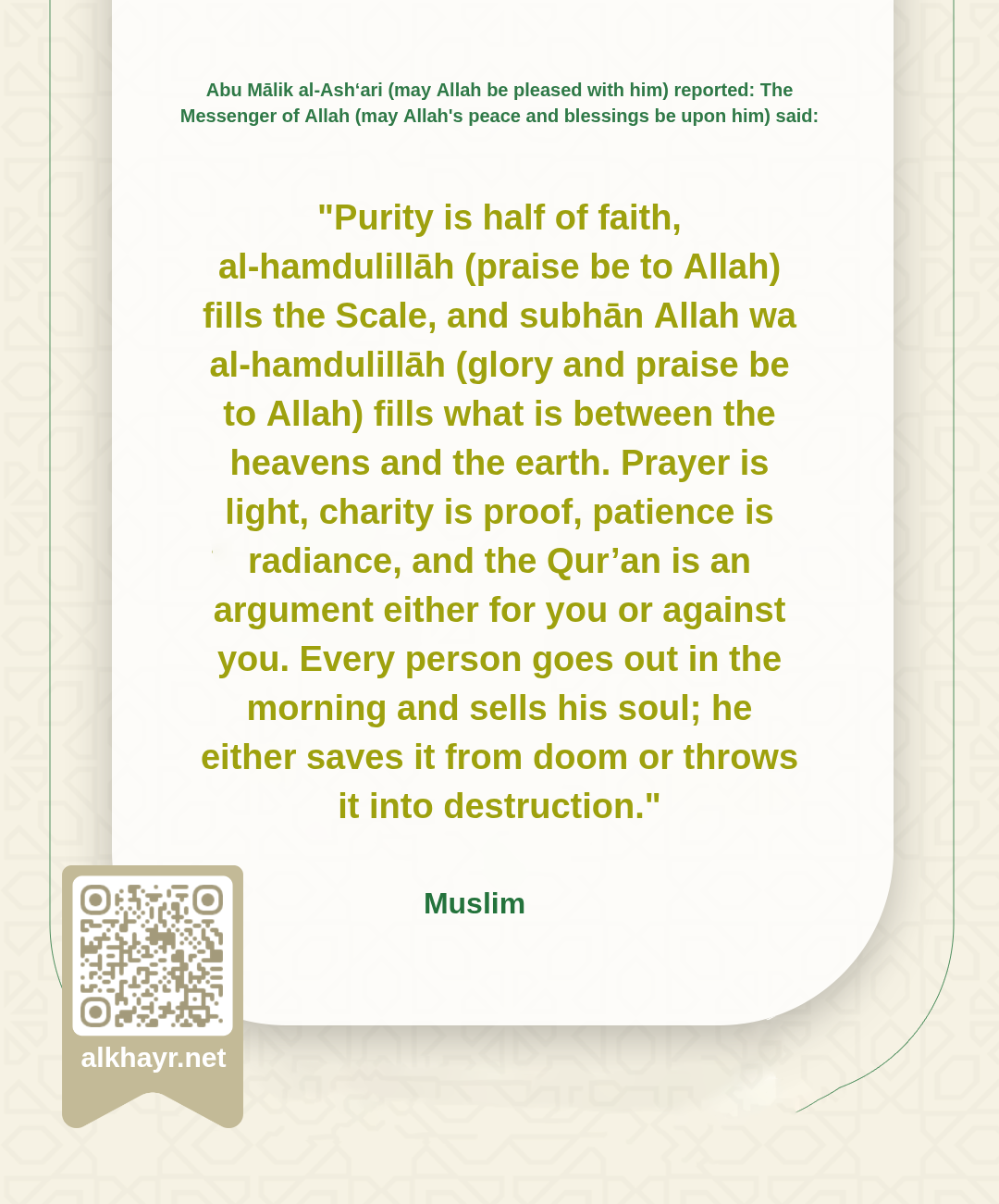
Abu Mālik al-Ash‘ari (may Allah be pleased with him) reported: The Messenger of Allah (may Allah's peace and blessings be upon him) said: "Purity is half of faith, al-hamdulillāh (praise be to Allah) fills the Scale, and subhān Allah wa al-hamdulillāh (glory and praise be to Allah) fills what is between the heavens and the earth. Prayer is light, charity is proof, patience is radiance, and the Qur’an is an argument either for you or against you. Every person goes out in the morning and sells his soul; he either saves it from doom or throws it into destruction."
Narrated by Muslim
‘Abdullāh ibn ‘Amr ibn al-‘Ās (may Allah be pleased with him) reported that he heard the Prophet (may Allah’s peace and blessings be upon him) say: "When you hear the Muezzin, say what he says and then invoke Allah's blessings upon me, for whoever invokes Allah's blessings upon me once, Allah will bestow His blessings upon him ten times. Then, ask Allah to grant me the Wasīlah, a high rank in Paradise that befits only one of Allah's servants, and I hope that I will be him. If anyone asks for Wasīlah for me , intercession will be permitted for him.”
Narrated by Muslim
Previous page
Page 8 of 10
Next page