Hadith for the World
Topic

Jurisprudence and Juristic Principles

288 hadiths

288 hadiths
Hudhayfah (may Allah be pleased with him) reported: When the Prophet (may Allah's peace and blessings be upon him) got up at night, he would cleanse his mouth with Siwak (tooth-stick).Agreed upon
‘Abdullāh ibn Zayd ibn ‘Āsim al-Māzini (may Allah be pleased with him) reported that a complaint was made to the Prophet (may Allah’s peace and blessings be upon him) about the person who doubts that something (breaking his ablution) has happened to him during his prayer, and he said: "He should not leave (his prayer) unless he hears a sound or perceives a smell."Narrated by Bukhari & Muslim
Abu Hurayrah (may Allah be pleased with him) reported: The Messenger of Allah (may Allah's peace and blessings be upon him) said: "Let not a believing man hate a believing woman. If he dislikes one of her characteristics, he will be pleased with another." Or he said: "another one."Narrated by Muslim
Abu Hurayrah (may Allah be pleased with him) reported that the Prophet (may Allah's peace and blessings be upon him) said: "Is he who raises his head before the Imam not afraid that Allah may transform his head into that of a donkey or his shape into that of a donkey?"Agreed upon
‘Ā’ishah (may Allah be pleased with her) reported: I heard the Messenger of Allah (may Allah's peace and blessings be upon him) say: "No prayer should be offered in the presence of food or when he is resisting the need to relieve himself of the two filths."Narrated by Muslim
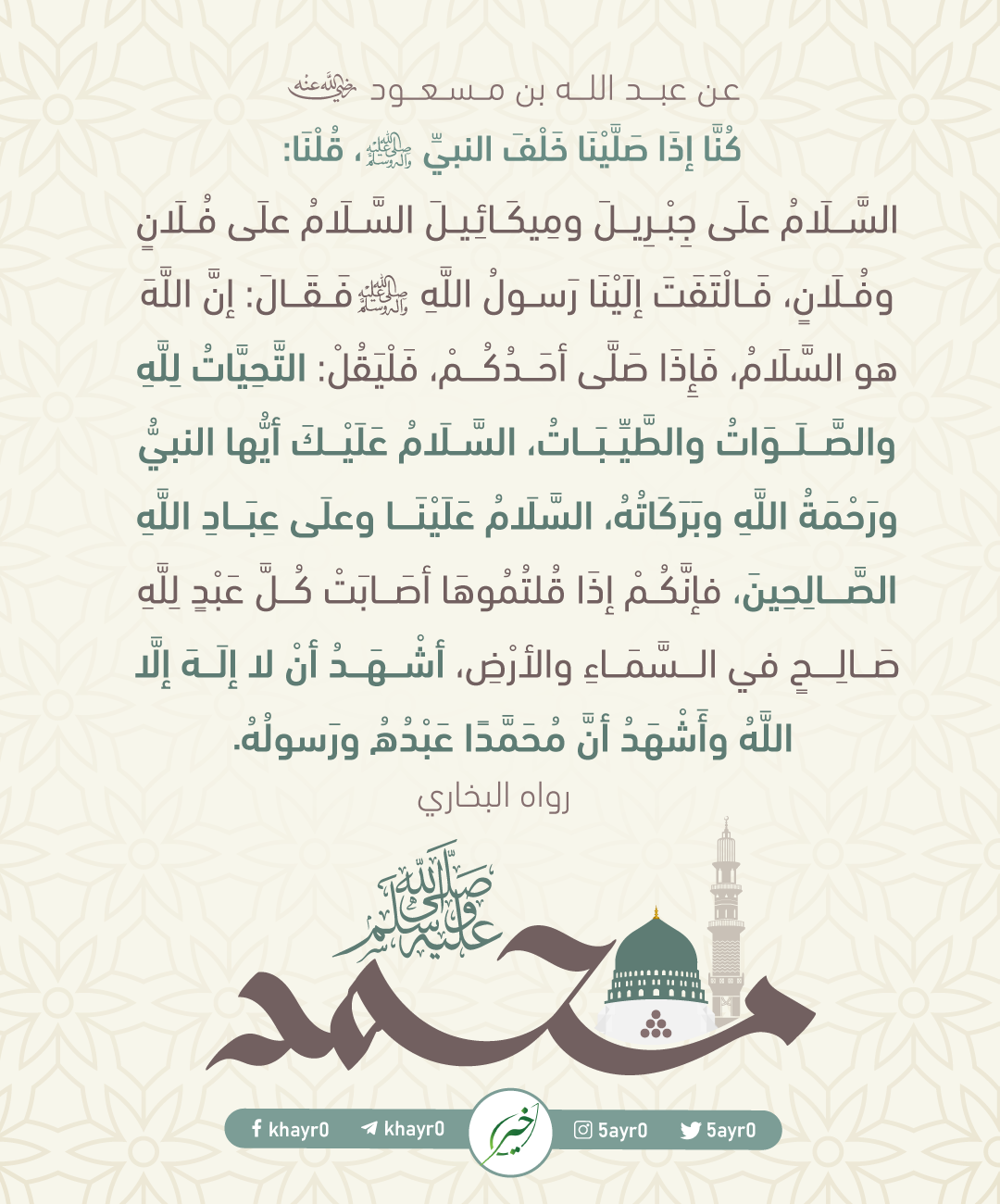
Ibn Mas‘ūd (may Allah be pleased with him) reported: The Messenger of Allah (may Allah's peace and blessings be upon him) taught me the Tashahhud, with my hand between his two hands, as he would teach me a Surah from the Qur’an: "At-tahiyyātu lillāhi was-salawātu wat-tayyibātu as-Salāmu ‘alayka ayyuha an-nabiyyu wa rahmatullāhi wa barakātuh, as-salāmu ‘alayna wa ‘ala ‘ibādillāhi as-sālihīn, ash-hadu alla ilāha illallāh wa ash-hadu anna Muhammadan ‘abduhu wa rasūluh (Greetings, prayers, and good things are due to Allah. May the peace, mercy, and blessings of Allah be upon you, O Prophet. Peace be upon us and upon the righteous slaves of Allah. I bear witness that there is no god but Allah, and I bear witness that Muhammad is His slave and Messenger)." Another wording reads: "Verily, Allah is the Giver of Peace, so when any of you sits in prayer, let him say: 'At-tahiyyātu lillāhi was-salawātu wat-tayyibātu as-salāmu ‘alayka ayyuha an-nabiyyu wa rahmatullāhi wa barakātuh, as-salāmu ‘alayna wa ‘ala ‘ibādillāhi as-sālihīn (Greetings, prayers, and good things are due to Allah. May the peace, mercy, and blessings of Allah be upon you, O Prophet. Peace be upon us and upon the righteous slaves of Allah).' If you say this, it will benefit every righteous slave of Allah in heaven and on earth. (Then, say:) 'Ash-hadu alla ilāha illallāh wa ash-hadu anna Muhammadan ‘abduhu wa rasūluh (I bear witness that there is no god but Allah, and I bear witness that Muhammad is His slave and Messenger).' Then, let him choose whatever supplication he would like."Agreed upon
Abu Mūsa al-Ash‘ari (may Allah be pleased with him) reported: The sun eclipsed during the time of the Messenger of Allah (may Allah's peace and blessings be upon him). He stood in great anxiety fearing that it might be the Doomsday, till he came to the mosque. He stood up to pray with prolonged standing and prostration such as I never saw him doing in prayer; and then he said: "These are the signs which Allah sends, not on account of the death of anyone or life of any one, but Allah sends them to frighten His servants thereby. So when you see any such thing, hasten to remember Him, supplicate Him, and beg pardon from Him."Narrated by Bukhari & Muslim
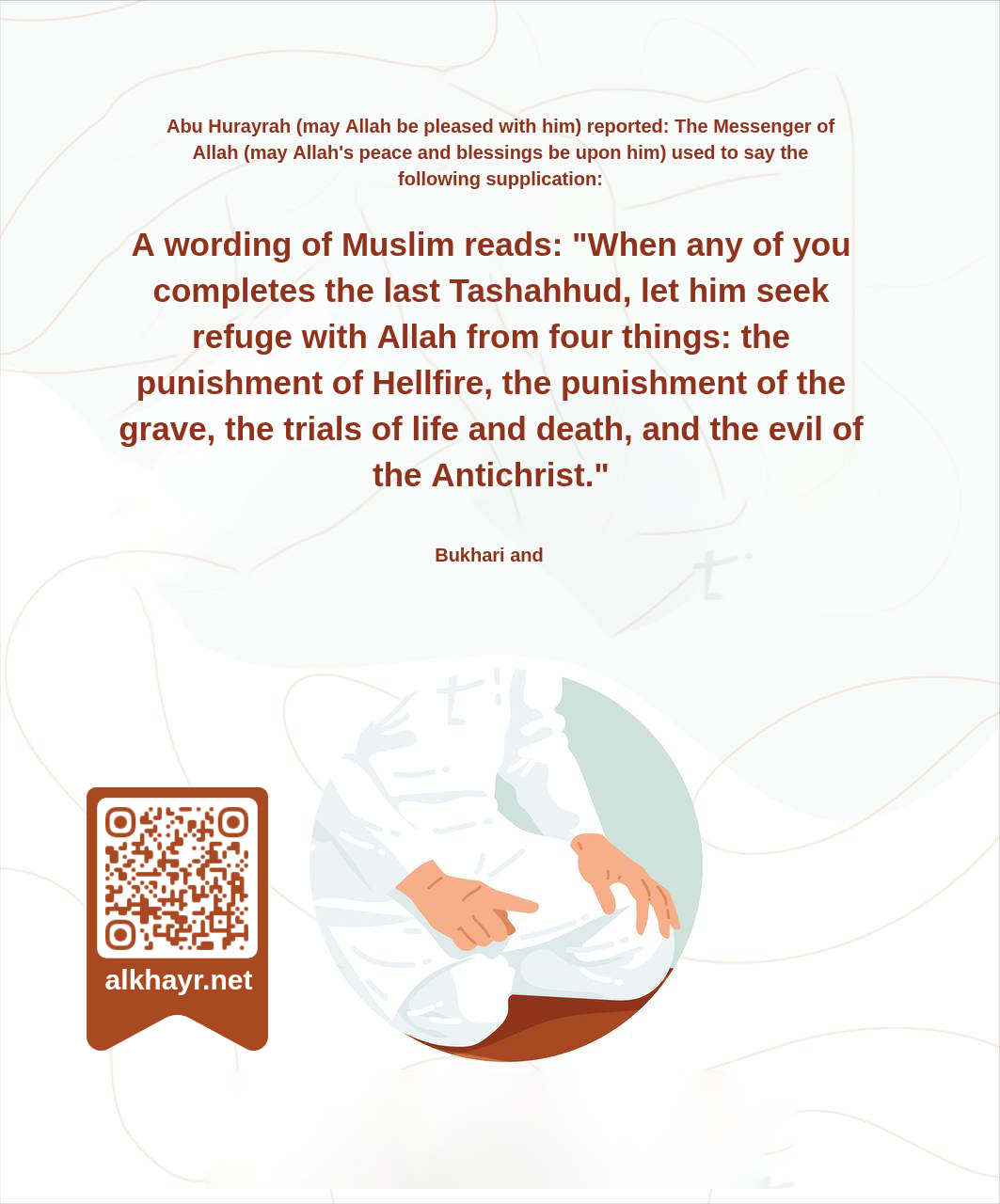
Abu Hurayrah (may Allah be pleased with him) reported: The Messenger of Allah (may Allah's peace and blessings be upon him) used to say the following supplication: "Allāuhumma inni a‘ūdhu bika min ‘adhāb al-qabr, wa min ‘adhāb an-nār, wa min fitnat al-mahya wa al-mamāt, wa min fitnat al-masīh ad-dajjāl (O Allah, I seek refuge with You from the punishment of the grave, the punishment of the Fire, the trials of life and death, and the trial of the Dajjāl (Antichrist)." A wording of Muslim reads: "When any of you completes the last Tashahhud, let him seek refuge with Allah from four things: the punishment of Hellfire, the punishment of the grave, the trials of life and death, and the evil of the Antichrist."Agreed upon
Abu Hurayrah (may Allah be pleased with him) reported: When the Messenger of Allah (may Allah's peace and blessings be upon him) made Takbīr in the prayer, he would remain silent a while before reciting. I said: O Messenger of Allah, may my father and mother ransom you! Have you seen your silence between Takbīr and the recitation? What is it that you say? He said: "I say: Allāhumma bā‘id bayni wa bayna khatāyāy kama bā‘dta bayna al-mashriqi wa al-maghrib. Allāhumma naqqini min khatāyāy kama yunaqqa ath-thawbu al-abyadu min ad-danas. Allāhumma ighsilni min khatāyāy bith-thalji wa al-mā’i wa al-barad (O Allah, distance me from my sins as You have distanced the east from the west. O Allah, purify me from my sins as a white garment is purified from dirt. O Allah, wash out my sins with water, snow, and hail)."Agreed upon
Abu Hurayrah (may Allah be pleased with him) reported: The Messenger of Allah (may Allah's peace and blessings be upon him) said: "If you say to your companion 'listen' on Friday while the Imām is delivering the sermon, you have thus engaged in idle talk."Agreed upon
‘Abdullāh ibn ‘Umar (may Allah be pleased with him) reported: Al-‘Abbās ibn ‘Abdul-Muttalib sought permission from the Messenger of Allah (may Allah's peace and blessings be upon him) to spend the nights of Mina in Makkah to provide (the pilgrims with) water, and he permitted him.Narrated by Bukhari & Muslim
Abu Hurayrah (may Allah be pleased with him) reported that the Prophet (may Allah's peace and blessings be upon him) said: "Hasten with the funeral, for if it is righteous, you will be taking it forward to what is good; and if it is otherwise, you will be laying evil off your necks."Agreed upon
Abu Hurayrah (may Allah be pleased with him) reported: I heard the Prophet (may Allah's peace and blessings be upon him) say: "Five are acts of Fitrah (natural disposition): circumcision, shaving the pubic hair, trimming the mustache, clipping the nails, and plucking the armpit hair."Agreed upon
Anas (may Allah be pleased with him) reported: The Prophet (may Allah's peace and blessings be upon him) used to say before entering the bathroom: "Allāhumma inni a‘ūdhu bika min al-khubuth wa al-khabā’ith (O Allah, I seek refuge in You from the male and female devils)."Agreed upon
Ibn ‘Abbās (may Allah be pleased with him and his father) reported that he said to ‘Atā’ ibn Abi Rabāh: Shall I show you a woman of the people of Paradise? ‘Atā’ said: Yes. He said: This black woman came to the Prophet (may Allah's peace and blessings be upon him) and said: I suffer from epilepsy and, as a result, my body becomes uncovered. So supplicate Allah for me. He said: "If you wish, be patient and you will enter Paradise; or, if you wish, I will supplicate Allah to cure you." She said: I will remain patient. She then said: But I become uncovered, so invoke Allah that I do not become uncovered. So he supplicated for her.Agreed upon
’Umm ‘Atiyyah (may Allah be pleased with her) reported: “We were forbidden to follow funeral processions, but the prohibition was not mandatory for us.”Agreed upon
Abu Hurayrah (may Allah be pleased with him) reported that the Messenger of Allah (may Allah's peace and blessings be upon him) said: "When a Muslim—or a believer—performs ablution, and he washes his face, every sin he has looked at with his eyes comes out of his face with the water or with the last drop of water. When he washes his hands, every sin he has struck with his hands comes out of his hands with the water or with the last drop of water. When he washes his feet, every sin his feet walked towards comes out with the water or with the last drop of water—until he comes out cleansed of sins."Narrated by Muslim
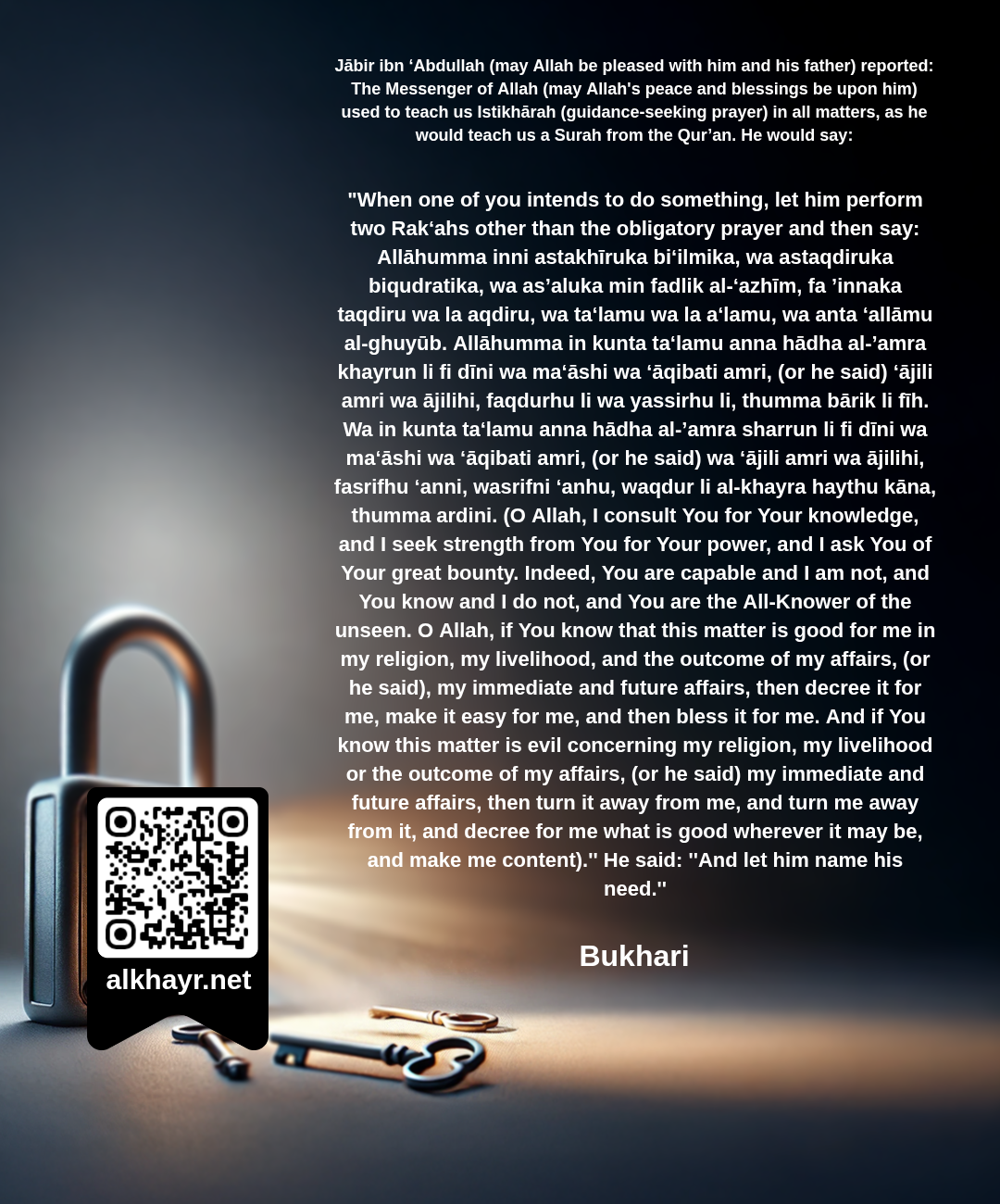
Jābir ibn ‘Abdullah (may Allah be pleased with him and his father) reported: The Messenger of Allah (may Allah's peace and blessings be upon him) used to teach us Istikhārah (guidance-seeking prayer) in all matters, as he would teach us a Surah from the Qur’an. He would say: "When one of you intends to do something, let him perform two Rak‘ahs other than the obligatory prayer and then say: Allāhumma inni astakhīruka bi‘ilmika, wa astaqdiruka biqudratika, wa as’aluka min fadlik al-‘azhīm, fa ’innaka taqdiru wa la aqdiru, wa ta‘lamu wa la a‘lamu, wa anta ‘allāmu al-ghuyūb. Allāhumma in kunta ta‘lamu anna hādha al-’amra khayrun li fi dīni wa ma‘āshi wa ‘āqibati amri, (or he said) ‘ājili amri wa ājilihi, faqdurhu li wa yassirhu li, thumma bārik li fīh. Wa in kunta ta‘lamu anna hādha al-’amra sharrun li fi dīni wa ma‘āshi wa ‘āqibati amri, (or he said) wa ‘ājili amri wa ājilihi, fasrifhu ‘anni, wasrifni ‘anhu, waqdur li al-khayra haythu kāna, thumma ardini. (O Allah, I consult You for Your knowledge, and I seek strength from You for Your power, and I ask You of Your great bounty. Indeed, You are capable and I am not, and You know and I do not, and You are the All-Knower of the unseen. O Allah, if You know that this matter is good for me in my religion, my livelihood, and the outcome of my affairs, (or he said), my immediate and future affairs, then decree it for me, make it easy for me, and then bless it for me. And if You know this matter is evil concerning my religion, my livelihood or the outcome of my affairs, (or he said) my immediate and future affairs, then turn it away from me, and turn me away from it, and decree for me what is good wherever it may be, and make me content).'' He said: ''And let him name his need.''Narrated by Al-Bukhāri

Anas ibn Mālik (may Allah be pleased with him) reported: The Prophet (may Allah's peace and blessings be upon him) passed by a woman who was weeping beside a grave. He said to her: "Fear Allah and be patient." She said to him: "Leave me alone, for you have not been afflicted with a calamity like mine." She did not recognize him. She was later informed that he was the Prophet (may Allah's peace and blessings be upon him). So, she went to his house and there she did not find any doormen. Then she said to him: "I did not recognize you." He said: "Indeed, patience is at the first shock." According to another narration: "She was crying over a son of hers.”Narrated by Bukhari & Muslim
Abu Sa‘īd al-Khudri (may Allah be pleased with him) reported that the Prophet (may Allah's peace and blessings be upon him) said: "Among the most wicked people in the sight of Allah on the Day of Judgment is the man who has sexual intercourse with a woman and then divulges her secret."Narrated by Muslim
Abu Hurayrah (may Allah be pleased with him) reported: The Prophet (may Allah’s peace and blessings be upon him) said: "O Allah, do not make my grave an idol that is worshiped. Allah cursed the people who took the graves of their prophets as places of worship."Narrated by Ahmad
Abu Hurayrah (may Allah be pleased with him) reported that the Prophet (may Allah's peace and blessings be upon him) said: "When you put on clothes and when you perform ablution, you should begin with your right side."Narrated by Ibn Majah - Narrated by At-Termedhy - Narrated by Abu Daoud - Narrated by Ahmad
Abu Hurayrah (may Allah be pleased with him) reported: The Messenger of Allah (may Allah's peace and blessings be upon him) said: "The most burdensome prayers for the hypocrites are the ‘Ishā’ and Fajr prayers. If they were to know the virtue of them, they would come to them, even if they had to crawl. I have almost intended to order for the prayer to be established, and appoint a man to lead the people in prayer, and then I would go along with some men having bundles of firewood, to the people who are not attending the prayer and burn their houses upon them with fire."Agreed upon
Abu Hurayrah (may Allah be pleased with him) reported: The Messenger of Allah (may Allah's peace and blessings be upon him) said: "My followers will be called on the Day of Resurrection with radiant foreheads and feet from the traces of ablution." So whoever can increase the area of his radiance should do so. And in a wording by Muslim: "I saw Abu Hurayrah performing ablution. He washed his face, then his arms until he almost reached the shoulders, and then he washed his feet up to the shins, and said: ‘I heard the Messenger of Allah (may Allah's peace and blessings be upon him) say: 'My followers will be called on the Day of Resurrection with radiant foreheads and feet from the traces of ablution.' So whoever can increase the area of his radiance should do so.'" And in another wording by Muslim: "I heard my close friend (may Allah's peace and blessings be upon him) say: ‘The adornment of the believer will reach as far as his ablution reaches.'"Muslim with its two versions - Narrated by Bukhari & Muslim