Hadith for the World
Topic

Jurisprudence and Juristic Principles

288 hadiths

288 hadiths
Abu Dharr (may Allah be pleased with him) reported that the Messenger of Allah (may Allah’s peace and blessings be upon him) said: "If you fast three days of the month, then fast the thirteenth, fourteenth and fifteenth." Qatādah ibn Milhān (may Allah be pleased with him) reported that the Messenger of Allah (may Allah’s peace and blessings be upon him) used to order us to fast the White Days: the thirteenth, fourteenth and fifteenth (of every lunar month)." Ibn ‘Abbās (may Allah be pleased with him) reported that the Messenger of Allah (may Allah’s peace and blessings be upon him) never broke his fast on the White Days, whether he was a resident or a traveler.”Narrated by Ibn Majah
Abu Hurayrah (may Allah be pleased with him) reported that the Prophet (may Allah's peace and blessings be upon him) said: "When the call to prayer is announced, the devil takes to his heels and breaks wind with noise so as not to hear the call. When the call to prayer is over, he returns. When the Iqāmah is announced, he takes to his heels, and after it is over, he returns again to distract the attention of the worshiper and make him remember things which were not on his mind before the prayer, saying: 'Remember such-and-such, and remember such-and-such,' until the worshiper forgets how many units of prayer he performed.”Narrated by Bukhari & Muslim
Mu‘ādhah al-‘Adawiyah reported that she asked ‘Ā’ishah (may Allah be pleased with her): “Did the Messenger of Allah (may Allah's peace and blessings be upon him) fast three days of each month?” ‘Ā’ishah replied: 'Yes.' Mu‘ādhah asked: “In which part of the month did he fast?” ‘Ā’ishah replied: “It did not matter to him in which part of the month he fasted.”Narrated by Muslim
Mu‘āwiyah (may Allah be pleased with him) reported: I heard the Messenger of Allah (may Allah's peace and blessings be upon him) say: "The muezzins will have the longest necks among the people on the Day of Judgment."Narrated by Muslim
Ibn ‘Abbās (may Allah be pleased with him) reported: The Messenger of Allah (may Allah's peace and blessings be upon him) fasted on the Day of ‘Āshūrā', and ordered Muslims to fast on it.Narrated by Bukhari & Muslim
Shurayh ibn Hāni' reported that he went to ‘Ā'ishah to ask her about wiping over the leather socks. She said: "You better go to ‘Ali ibn Abi Tālib and ask him, because he used to travel with the Messenger of Allah (may Allah's peace and blessings be upon him)." So, we asked him and he said: "The Messenger of Allah (may Allah's peace and blessings be upon him) set a limit of three days with their nights for the traveler, and one day and night for the one who is not traveling."Narrated by Muslim
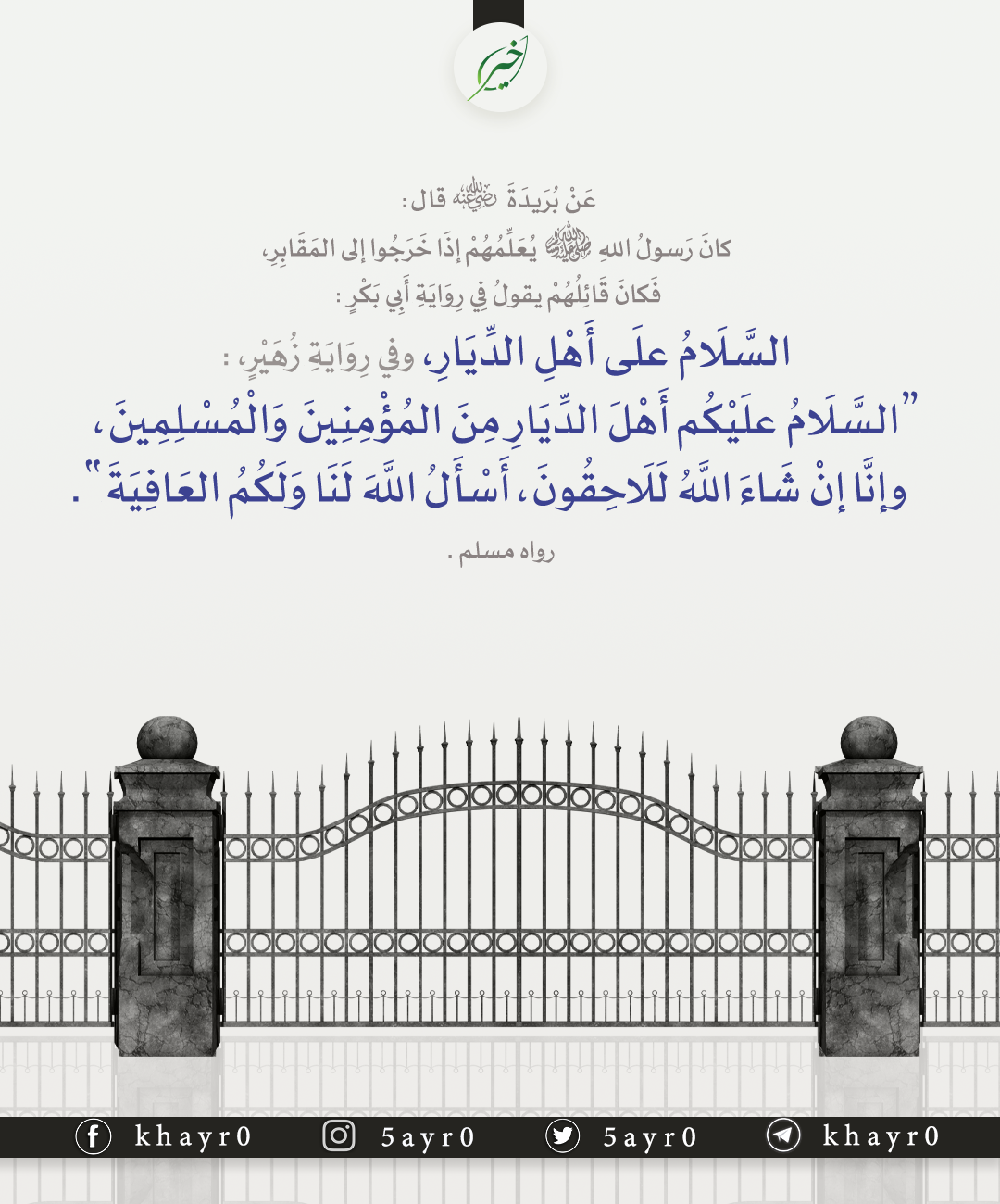
‘Ā'ishah (may Allah be pleased with her) said: "Should I not tell you about me and the Messenger of Allah (may Allah's peace and blessings be upon him)?" We said: 'Yes.' She said that when it was my turn and the Messenger of Allah (may Allah's peace and blessings be upon him) was to spend the night with me, he turned, took off his mantle and his shoes and placed them near his feet. Then, he spread the end of his lower garment on his bed and lay down until he thought that I had gone to sleep. He took hold of his mantle slowly and put on his shoes slowly, and opened the door and went out and then closed it gently. I put on my head cover and my veil and tightened my lower garment, and then went out following his steps until he reached Al-Baqī‘. He stood there for a long time. He then lifted his hands three times, and then returned and I also returned. He hastened his steps and I also hastened my steps. He ran and I ran too. He came (to the house) and I also came (to the house). I, however, preceded him and I entered (the house), and as I lay down in bed, he entered and said: "Why is it, O ‘Ā'ish, that you are out of breath?" I said: 'Nothing.' He said: "Tell me or the Subtle and the Aware will inform me." I said: "O Messenger of Allah, may my father and mother be sacrificed for you." Then I told him everything. He said: "So, you were the darkness that I saw in front of me?" I said: 'Yes.' He struck me on the chest and it was painful, and then said: "Did you think that Allah and His Messenger would be unfair to you?" I said: "Whatever people conceal, Allah knows it. Yes." He said: "Jibrīl came to me when you saw me. He called me and he concealed it from you. I responded to his call, but I too concealed it from you, as he would never enter upon you while you are undressed. I thought that you had gone to sleep, and I did not like to awaken you, fearing that you might be afraid of being left alone. Jibrīl said to me: 'Your Lord commands you to go to the inhabitants of Al-Baqī‘ and seek forgiveness for them."' I said: "O Messenger of Allah, what should I say to them?" He said: "Say: Peace be upon the inhabitants of this place among the believers and Muslims. May Allah have mercy upon those who have gone on ahead of us and those who come later on, and we will join you, if Allah wills."Narrated by Muslim

Abu Hurayrah (may Allah be pleased with him) reported that the Prophet (may Allah's peace and blessings be upon him) said: "When it is Friday, the angels stand at the door of the mosque and keep on writing the names of those coming in order of their arrival. The example of the one who enters the mosque in the earliest hour is that of the one offering a camel (as a sacrifice). The one coming next is like the one offering a cow, then a ram, then a chicken, then an egg respectively. When the Imām comes out (for the Friday prayer), they (i.e. the angels) fold their scrolls and listen to the sermon.”Narrated by Bukhari & Muslim
Abu Hurayrah (may Allah be pleased with him) reported that the Messenger of Allah (may Allah's peace and blessings be upon him) said: "There are angels at the entrances of Madīnah, so neither the plague nor the Antichrist shall enter it."Narrated by Bukhari & Muslim
Abu Mūsa (may Allah be pleased with him) reported that the Messenger of Allah (may Allah's peace and blessings be upon him) said: "The death of my Ummah is by stabbing and the plague." It was said: "O Messenger of Allah, as for stabbing, we know it, but what is the plague?" He said: "Jabbing by your enemies from among the Jinn. In both cases, there are martyrs."Narrated by Ahmad
Abu Hurayrah (may Allah be pleased with him) reported that the Messenger of Allah (may Allah's peace and blessings be upon him) said: "When the son of Adam recites a verse of prostration and then falls down in prostration, the devil retreats, weeps, and says: 'Woe unto him! – In the narration of Abu Kurayb the words are: Woe unto me – the son of Adam was commanded to prostrate, and he prostrated, so Paradise is for him. However, I was commanded to prostrate, but I refused to, so the Fire is for me.'"Narrated by Muslim
Abu Hurayrah (may Allah be pleased with him) reported that the Messenger (may Allah's peace and blessings be upon him) said: "Whoever catches one Rak‘ah before sunrise, he has caught the Fajr prayer, and whoever catches one Rak‘ah of the ‘Asr prayer before sunset, he has caught the ‘Asr prayer."Narrated by Bukhari & Muslim
‘Uqbah ibn ‘Āmir al-Juhani (may Allah be pleased with him) reported: Three hours the Messenger of Allah (may Allah's peace and blessings be upon him) used to forbid us from praying or burying our deceased ones in them: when the sun begins to rise until it has fully risen; when the sun is at its zenith until it begins to decline; and when the sun starts setting until it has fully set.Narrated by Muslim
Jubayr ibn Mut‘im (may Allah be pleased with him) reported that the Prophet (may Allah's peace and blessings be upon him) said: "Do not prevent anyone from circumambulating this House and from praying at any time of the day or night as they wish."Narrated by Ibn Majah - Narrated by At-Termedhy - An-Nasaa’i - Narrated by Abu Daoud - Narrated by Ahmad - Ad-Daarimi
Jābir ibn ‘Abdullah (may Allah be pleased with him and his father) reported that the Messenger of Allah (may Allah's peace and blessings be upon him) said: "Whoever says upon hearing the call: O Allah, Lord of this perfect call and the prayer that is to be established, grant Muhammad Al-Wasīlah and Al-Fadīlah and resurrect him to the Praiseworthy Station that You have promised him, he will be granted my intercession on the Day of Judgment."Narrated by Al-Bukhāri
Abu Marthad al-Ghanawi (may Allah be pleased with him) reported: The Messenger of Allah (may Allah's peace and blessings be upon him) said: "Do not sit on graves, and do not pray towards them."Narrated by Muslim
‘Abdullāh ibn Ash-Shikhkhīr (may Allah be pleased with him) reported: I saw the Messenger of Allah (may Allah's peace and blessings be upon him) praying and making a sound like the rumbling of a mill because of weeping.An-Nasaa’i - Narrated by Abu Daoud - Narrated by Ahmad
Anas ibn Mālik (may Allah be pleased with him) reported that the Messenger of Allah (may Allah's peace and blessings be upon him) said: "If the supper is served, then start eating it before praying the Maghrib prayer, and do not be hasty in finishing it."Narrated by Bukhari & Muslim
Anas ibn Mālik (may Allah be pleased with him) reported that the Prophet (may Allah's peace and blessings be upon him) saw mucus in the prayer's direction. That was difficult for him to bear, and the feeling was even reflected in his face. Therefore, he stood up and scratched the mucus with his hand and said: "When one of you stands to pray, he is privately conversing with his Lord, or his Lord is between him and the prayer direction. So let no one of you spit in the direction of prayer, but only to his left or under his feet." Then he took a corner of his garment, spat into it, folded it up, and said: "Or he should do like this."Narrated by Bukhari & Muslim
Anas ibn Mālik (may Allah be pleased with him) reported: The Prophet (may Allah's peace and blessings be upon him) said: "What is the matter with some people who raise their eyes towards the sky during their prayer?" He went on, using strict words, until he said, "They must stop that, or their eyesight will be snatched away."Narrated by Al-Bukhāri
‘Ā’ishah, the Mother of the Believers, (may Allah be pleased with her) reported: ’Umm Salamah mentioned to the Messenger of Allah (may Allah's peace and blessings be upon him) that she had seen a church in Abyssinia called Māriyah, and she mentioned the images that she had seen therein. The Messenger of Allah (may Allah's peace and blessings be upon him) said: "Those are a people who, when a righteous slave or a righteous man from among them dies, they build a place of worship over his grave and place those images therein. Those are the most evil people in the sight of Allah."Agreed upon
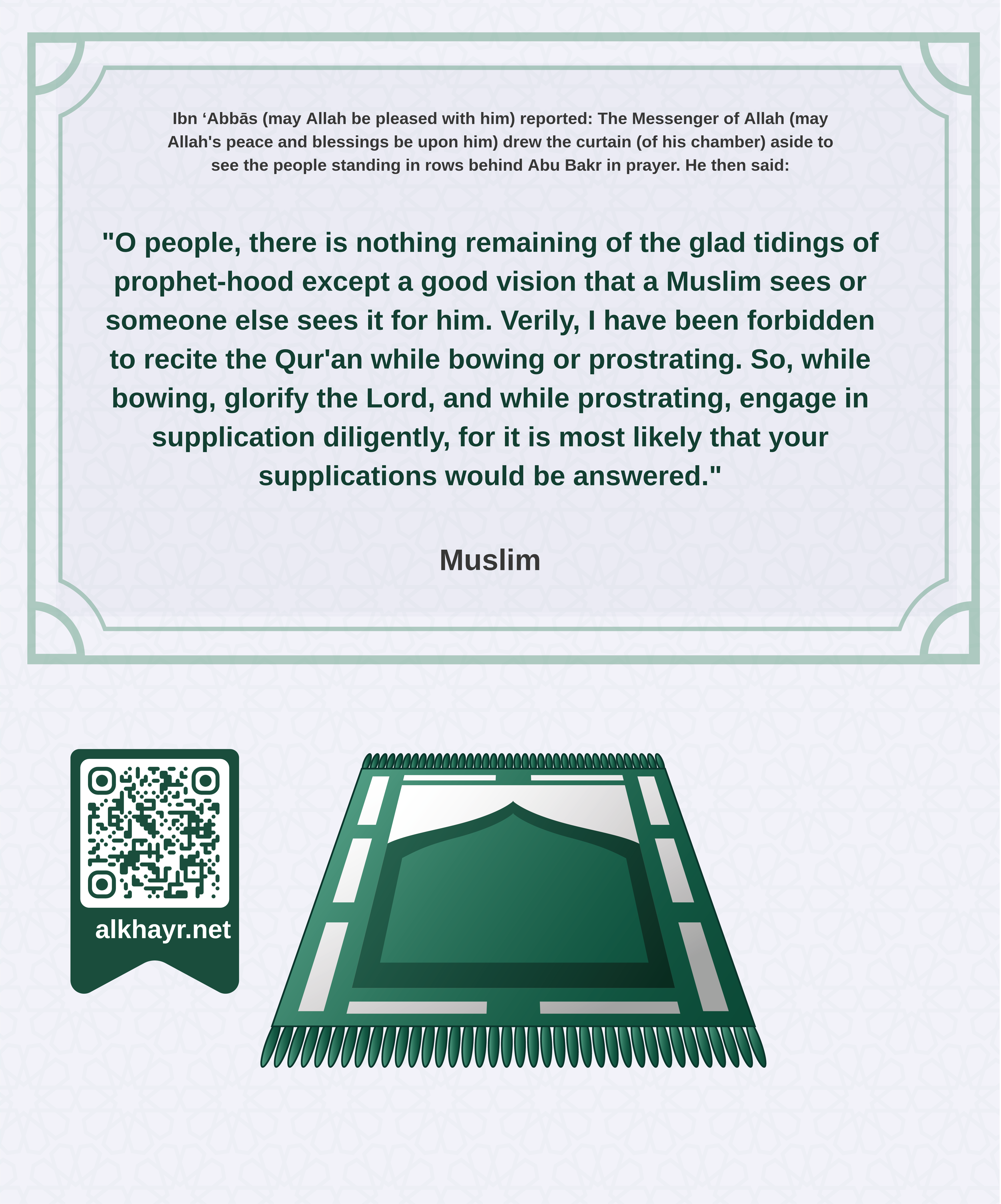
Ibn ‘Abbās (may Allah be pleased with him) reported: The Messenger of Allah (may Allah's peace and blessings be upon him) drew the curtain (of his chamber) aside to see the people standing in rows behind Abu Bakr in prayer. He then said: "O people, there is nothing remaining of the glad tidings of prophet-hood except a good vision that a Muslim sees or someone else sees it for him. Verily, I have been forbidden to recite the Qur'an while bowing or prostrating. So, while bowing, glorify the Lord, and while prostrating, engage in supplication diligently, for it is most likely that your supplications would be answered."Narrated by Muslim
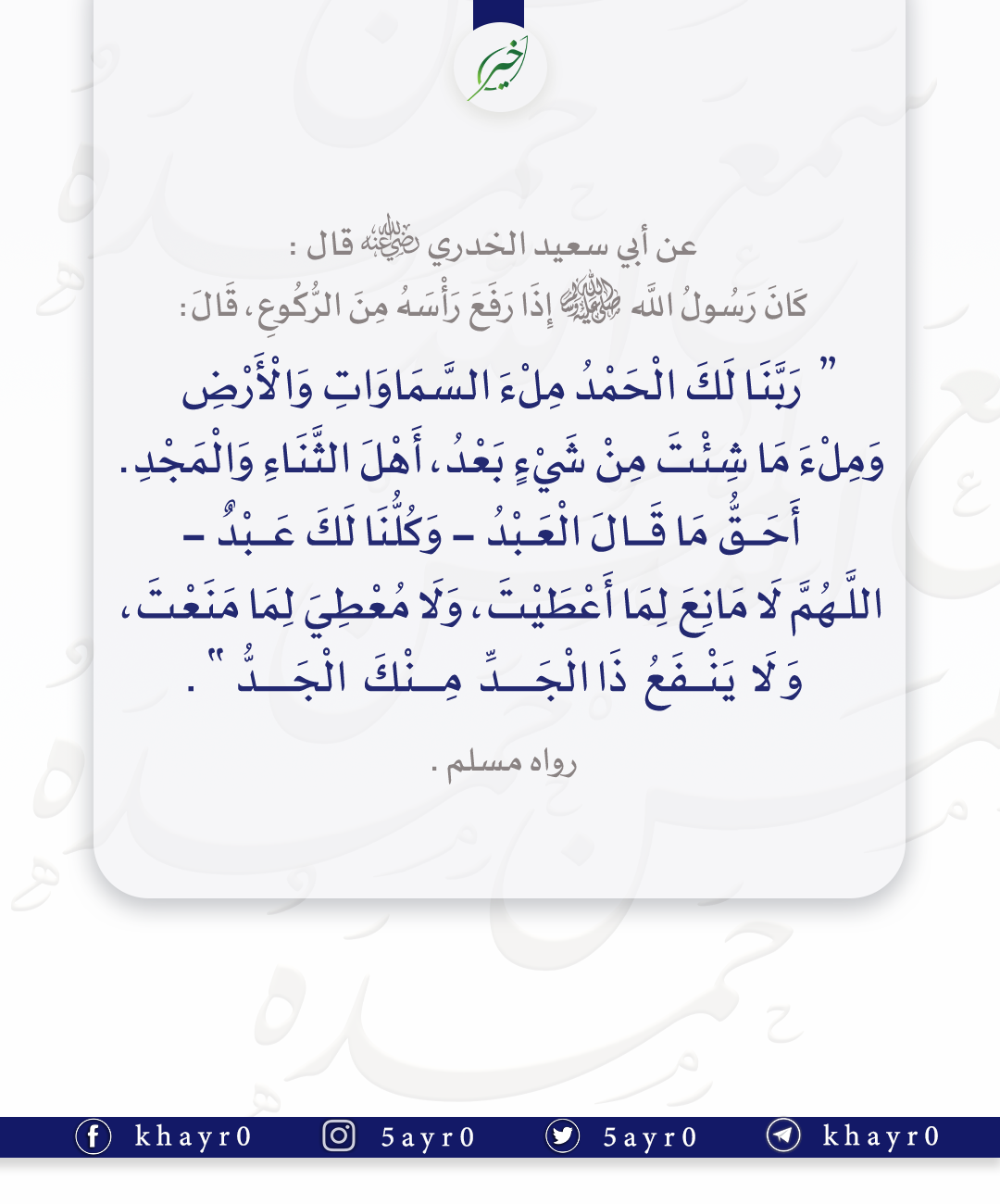
Al-Hakam reported: Kufah was conquered by a man called Zamān ibn al-Ash‘ath. He ordered Abu ‘Ubaydah ibn ‘Abdullāh to lead people in prayer. When he performed the prayer, he would rise from bowing and stand for as long it took me to say: "O Allah, our Lord, to You is all praise that fills the heavens and earth and whatever You will beyond that. All praise and glory belong to You. No one can withhold what You have given and no one can give what You have withheld. And the good fortune of a person will not avail him before You." Al-Hakam added: "I mentioned this to ‘Abdur-Rahmān ibn Abu Layla and he said: ‘I head Al-Barā' ibn ‘Āzib say: 'In the prayer of the Messenger of Allah (may Allah's peace and blessings be upon him), the bowing, rising from bowing, prostration, and sitting between the two prostrations were all roughly the same (in length).''' Shu‘bah said: "I related this to ‘Amr ibn Murrah and he said: ‘I saw Ibn Abu Layla, and his prayer was not like that.'"Narrated by Muslim
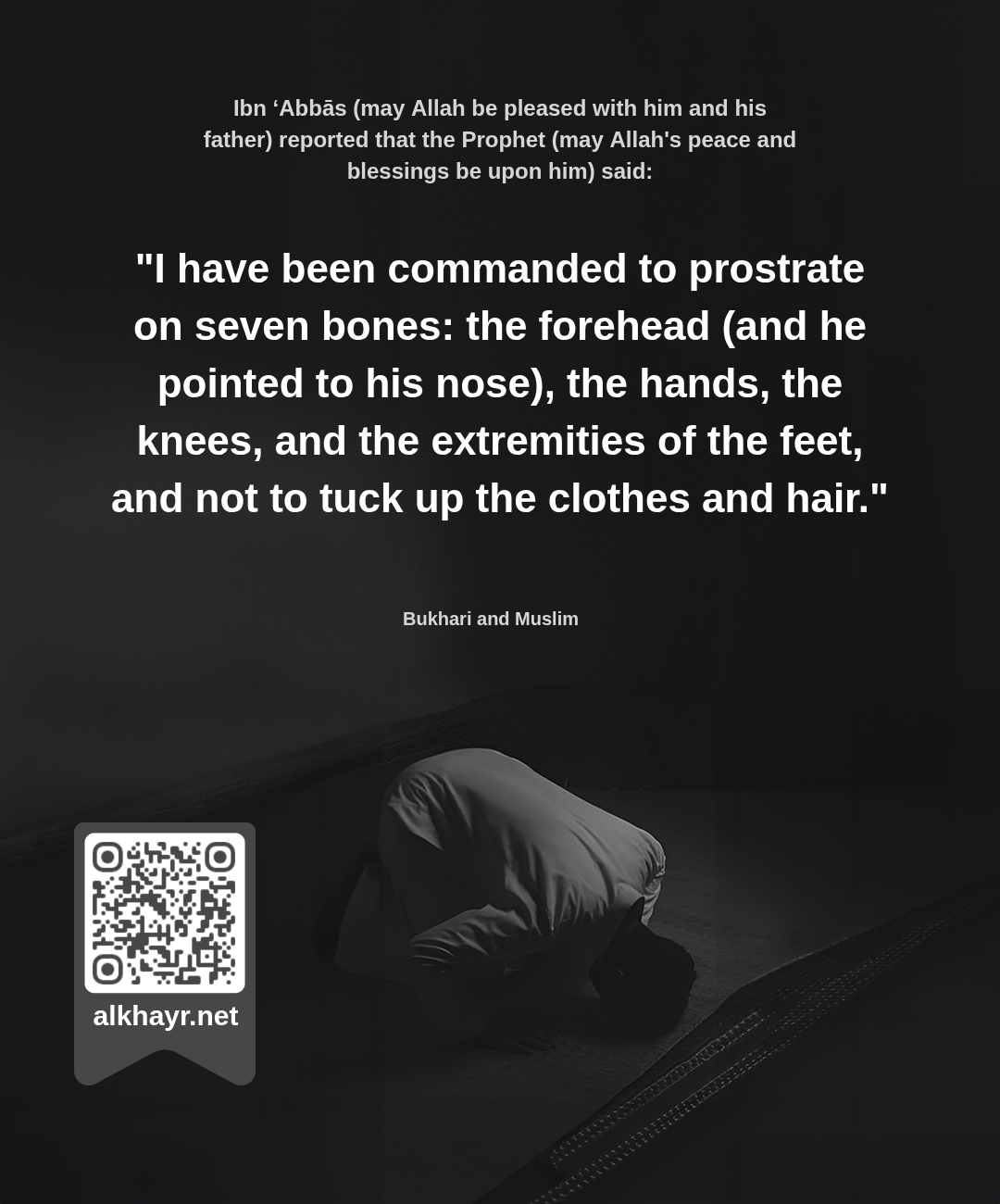
Ibn ‘Abbās (may Allah be pleased with him and his father) reported that the Prophet (may Allah's peace and blessings be upon him) said: "I have been commanded to prostrate on seven bones: the forehead (and he pointed to his nose), the hands, the knees, and the extremities of the feet, and not to tuck up the clothes and hair."Agreed upon